
Sum Root to Leaf Numbers
MedPrompt
You are given the root of a binary tree containing digits from 0 to 9 only.
Each root-to-leaf path in the tree represents a number.
- For example, the root-to-leaf path
1 -> 2 -> 3represents the number123.
Return the total sum of all root-to-leaf numbers. Test cases are generated so that the answer will fit in a 32-bit integer.
A leaf node is a node with no children.
Example 1:
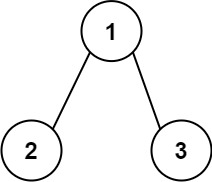
1->2Example 2:
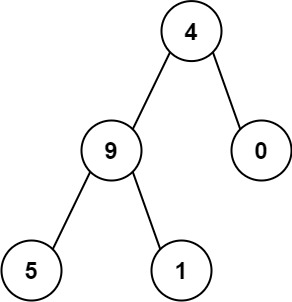
4->9->5
Constraints:
- The number of nodes in the tree is in the range
[1, 1000]. 0 <= Node.val <= 9- The depth of the tree will not exceed
10.
Approaches
3 approaches with complexity analysis and trade-offs.
This approach first generates all root-to-leaf paths, stores them, and then iterates through these paths to calculate the corresponding numbers and their sum. It's straightforward but inefficient due to high space usage.
Algorithm
- Initialize an empty list,
allPaths, to store string representations of the numbers for each root-to-leaf path. - Define a recursive helper function
findPaths(node, currentPathString, allPaths). - In the helper function, if the current
nodeis null, return. - Append the current node's value to
currentPathString. - If the current
nodeis a leaf (both left and right children are null), add thecurrentPathStringto theallPathslist. - Recursively call the helper function for the left and right children.
- After the initial call to
findPathson the root completes, iterate throughallPaths. - For each string in
allPaths, convert it to an integer and add it to atotalSum. - Return
totalSum.
Walkthrough
The core idea is to separate the problem into two distinct steps: path finding and summation.
-
Path Finding: A Depth-First Search (DFS) traversal is used to find all paths from the root to every leaf node. We use a helper function that maintains the current path from the root. When a leaf is encountered, the current path is complete and is added to a list of all paths.
-
Summation: After the traversal is complete, we have a list of all paths (where each path is a list of digits). We iterate through this list. For each path, we convert the sequence of digits into an integer. For example, the path
[4, 9, 5]is converted to the number 495. These numbers are then added to a running total.
Here is a code snippet illustrating this approach:
import java.util.ArrayList;import java.util.List; class Solution { public int sumNumbers(TreeNode root) { List<String> allPaths = new ArrayList<>(); findPaths(root, "", allPaths); int totalSum = 0; for (String path : allPaths) { totalSum += Integer.parseInt(path); } return totalSum; } private void findPaths(TreeNode node, String currentPath, List<String> allPaths) { if (node == null) { return; } currentPath += node.val; if (node.left == null && node.right == null) { allPaths.add(currentPath); return; } findPaths(node.left, currentPath, allPaths); findPaths(node.right, currentPath, allPaths); }}Complexity
Time
O(N*H)
Space
O(N*H)
Trade-offs
Pros
The logic is separated into two clear, understandable steps: finding paths and then summing them.
It's a direct translation of the problem statement.
Cons
Very inefficient in terms of space. It requires storing all root-to-leaf paths, which can be memory-intensive for large trees.
The time complexity is also suboptimal due to the overhead of creating and storing path strings/lists and then iterating over them again.
Solutions
Solution
/** * Definition for a binary tree node. * public class TreeNode { * int val; * TreeNode left; * TreeNode right; * TreeNode() {} * TreeNode(int val) { this.val = val; } * TreeNode(int val, TreeNode left, TreeNode right) { * this.val = val; * this.left = left; * this.right = right; * } * } */ class Solution { public int sumNumbers ( TreeNode root ) { return dfs ( root , 0 ); } private int dfs ( TreeNode root , int s ) { if ( root == null ) { return 0 ; } s = s * 10 + root . val ; if ( root . left == null && root . right == null ) { return s ; } return dfs ( root . left , s ) + dfs ( root . right , s ); } }Video walkthrough
Newsletter
One sharp idea, every week
System design and interview prep — short enough to finish.
No spam. Unsubscribe anytime.
Practice
Same difficulty — related problems to reinforce the pattern.