
The Skyline Problem
HardPrompt
A city's skyline is the outer contour of the silhouette formed by all the buildings in that city when viewed from a distance. Given the locations and heights of all the buildings, return the skyline formed by these buildings collectively.
The geometric information of each building is given in the array buildings where buildings[i] = [lefti, righti, heighti]:
leftiis the x coordinate of the left edge of theithbuilding.rightiis the x coordinate of the right edge of theithbuilding.heightiis the height of theithbuilding.
You may assume all buildings are perfect rectangles grounded on an absolutely flat surface at height 0.
The skyline should be represented as a list of "key points" sorted by their x-coordinate in the form [[x1,y1],[x2,y2],...]. Each key point is the left endpoint of some horizontal segment in the skyline except the last point in the list, which always has a y-coordinate 0 and is used to mark the skyline's termination where the rightmost building ends. Any ground between the leftmost and rightmost buildings should be part of the skyline's contour.
Note: There must be no consecutive horizontal lines of equal height in the output skyline. For instance, [...,[2 3],[4 5],[7 5],[11 5],[12 7],...] is not acceptable; the three lines of height 5 should be merged into one in the final output as such: [...,[2 3],[4 5],[12 7],...]
Example 1:
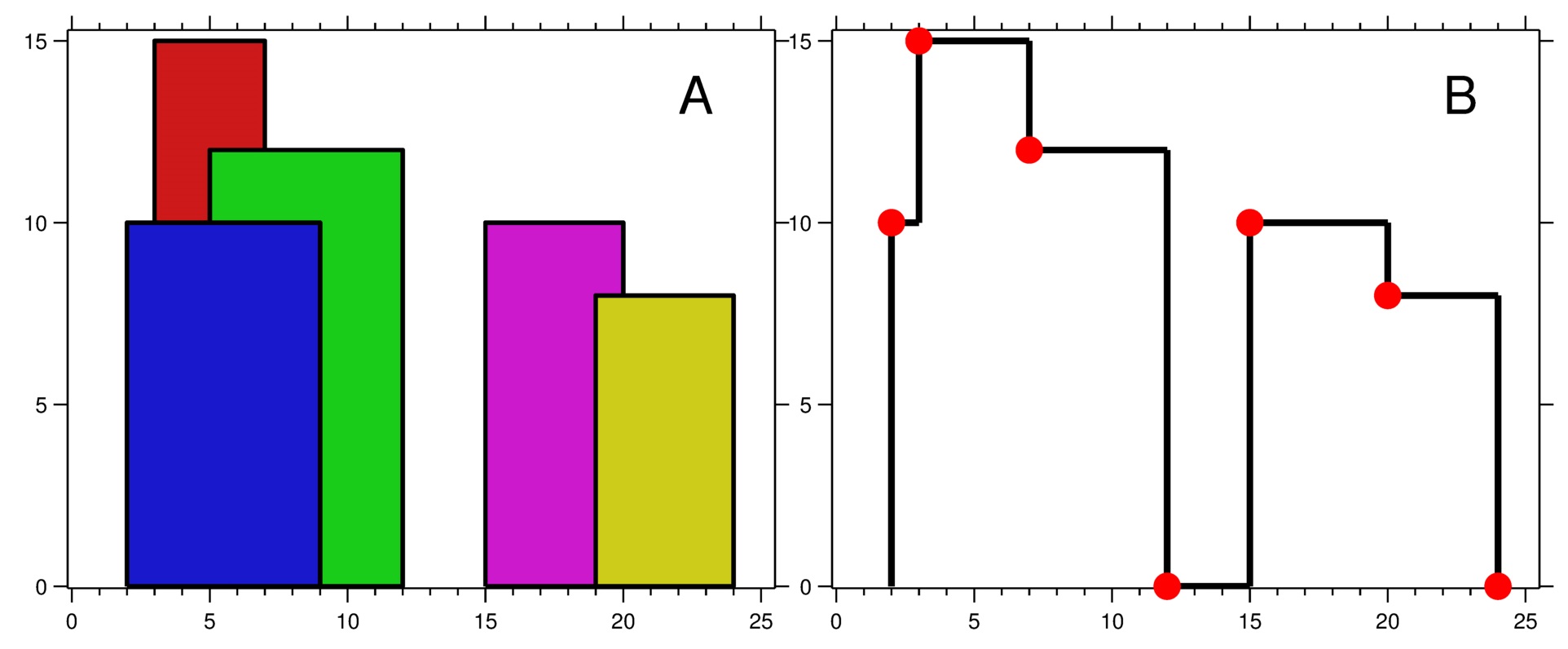
Input: buildings = [[2,9,10],[3,7,15],[5,12,12],[15,20,10],[19,24,8]]
Output: [[2,10],[3,15],[7,12],[12,0],[15,10],[20,8],[24,0]]
Explanation:
Figure A shows the buildings of the input.
Figure B shows the skyline formed by those buildings. The red points in figure B represent the key points in the output list.
Example 2:
Input: buildings = [[0,2,3],[2,5,3]]
Output: [[0,3],[5,0]]
Constraints:
1 <= buildings.length <= 1040 <= lefti < righti <= 231 - 11 <= heighti <= 231 - 1buildingsis sorted byleftiin non-decreasing order.
Approaches
3 approaches with complexity analysis and trade-offs.
The brute force approach involves checking the height at each x-coordinate by scanning through all buildings.
Algorithm
- Find the minimum and maximum x-coordinates among all buildings
- For each x-coordinate from min to max:
- Find maximum height among all buildings at current x
- If height changes from previous, add to result
- Add final point with height 0
Walkthrough
For each x-coordinate from the leftmost building to the rightmost building:
- Find the maximum height among all buildings that contain this x-coordinate
- If this height is different from the previous height, add it to the result
Here's the implementation:
class Solution { public List<List<Integer>> getSkyline(int[][] buildings) { // Find min and max x-coordinates int minX = Integer.MAX_VALUE, maxX = Integer.MIN_VALUE; for (int[] building : buildings) { minX = Math.min(minX, building[0]); maxX = Math.max(maxX, building[1]); } List<List<Integer>> result = new ArrayList<>(); int prevHeight = 0; // Check each x-coordinate for (int x = minX; x <= maxX; x++) { int maxHeight = 0; // Find max height at current x for (int[] building : buildings) { if (x >= building[0] && x < building[1]) { maxHeight = Math.max(maxHeight, building[2]); } } // If height changes, add to result if (maxHeight != prevHeight) { result.add(Arrays.asList(x, maxHeight)); prevHeight = maxHeight; } } // Add final point result.add(Arrays.asList(maxX, 0)); return result; }}Complexity
Time
O(n * w) where n is number of buildings and w is width (max_x - min_x)
Space
O(1) excluding the space needed for output
Trade-offs
Pros
Simple to understand and implement
Works for small inputs
No extra space needed except for output
Cons
Very inefficient for large inputs
Checks every x-coordinate even when unnecessary
Time complexity depends on width of skyline
Solutions
Solution
import java.util.* ; public class The_Skyline_Problem { public static void main ( String [] args ) { The_Skyline_Problem out = new The_Skyline_Problem (); Solution_Heap s = out . new Solution_Heap (); // output: [ [2 10], [3 15], [7 12], [12 0], [15 10], [20 8], [24, 0] ] s . getSkyline ( new int [][]{ { 2 , 9 , 10 }, { 3 , 7 , 15 }, { 5 , 12 , 12 }, { 15 , 20 , 10 }, { 19 , 24 , 8 } } ) . stream (). forEach ( System . out :: println ); } class Solution_Heap { public List < List < Integer >> getSkyline ( int [][] buildings ) { List < List < Integer >> result = new ArrayList <>(); if ( buildings == null || buildings . length == 0 || buildings [ 0 ]. length == 0 ) { return result ; } List < Edge > edges = new ArrayList < Edge >(); // add all left/right edges for ( int [] each: buildings ) { edges . add ( new Edge ( each [ 0 ], each [ 2 ], true )); edges . add ( new Edge ( each [ 1 ], each [ 2 ], false )); } // sort edges, NlogN Collections . sort ( edges , ( a , b ) -> { if ( a . x != b . x ) { return Integer . compare ( a . x , b . x ); } if ( a . isStart && b . isStart ) { return Integer . compare ( b . height , a . height ); // higher edge at front } if (! a . isStart && ! b . isStart ) { return Integer . compare ( a . height , b . height ); // lower edge at front } return a . isStart ? - 1 : 1 ; // lower edge at front }); // process edges, comparator is reverseOrder() PriorityQueue < Integer > heightHeap = new PriorityQueue < Integer >( Collections . reverseOrder ()); for ( Edge edge : edges ) { if ( edge . isStart ) { if ( heightHeap . isEmpty () || edge . height > heightHeap . peek ()) { result . add ( Arrays . asList ( edge . x , edge . height )); } heightHeap . add ( edge . height ); } else { heightHeap . remove ( edge . height ); if ( heightHeap . isEmpty ()){ result . add ( Arrays . asList ( edge . x , 0 ) ); // last point } else if ( edge . height > heightHeap . peek ()){ // @note: intersect result . add ( Arrays . asList ( edge . x , heightHeap . peek ()) ); } } } return result ; } class Edge { int x ; // x坐标 int height ; boolean isStart ; public Edge ( int x , int height , boolean isStart ) { this . x = x ; this . height = height ; this . isStart = isStart ; } } } // merge sort example public class Solution_mergeSort { public List < int []> getSkyline ( int [][] buildings ) { if ( buildings == null || buildings . length == 0 ) { return new LinkedList < int []>(); } return getSkyline ( buildings , 0 , buildings . length - 1 ); } // NlogN private LinkedList < int []> getSkyline ( int [][] buildings , int lo , int hi ) { if ( lo < hi ) { int mid = lo + ( hi - lo ) / 2 ; return mergeSkylines ( getSkyline ( buildings , lo , mid ), getSkyline ( buildings , mid + 1 , hi )); } else { // lo == hi, base case, add the final already-merged building to skyline LinkedList < int []> skyline = new LinkedList < int []>(); skyline . add ( new int []{ buildings [ lo ][ 0 ], buildings [ lo ][ 2 ]}); // only care about [left-index, height] skyline . add ( new int []{ buildings [ lo ][ 1 ], 0 }); // right-index is just for last right edge return skyline ; } } // merge two Skylines private LinkedList < int []> mergeSkylines ( LinkedList < int []> skyline1 , LinkedList < int []> skyline2 ) { LinkedList < int []> skyline = new LinkedList < int []>(); int height1 = 0 , height2 = 0 ; while ( skyline1 . size () > 0 && skyline2 . size () > 0 ) { int index = 0 , height = 0 ; // @note: always remove the smaller index first, so order is guaranteed if ( skyline1 . getFirst ()[ 0 ] < skyline2 . getFirst ()[ 0 ]) { index = skyline1 . getFirst ()[ 0 ]; height1 = skyline1 . getFirst ()[ 1 ]; height = Math . max ( height1 , height2 ); skyline1 . removeFirst (); } else if ( skyline1 . getFirst ()[ 0 ] > skyline2 . getFirst ()[ 0 ]) { index = skyline2 . getFirst ()[ 0 ]; height2 = skyline2 . getFirst ()[ 1 ]; height = Math . max ( height1 , height2 ); skyline2 . removeFirst (); } else { index = skyline1 . getFirst ()[ 0 ]; height1 = skyline1 . getFirst ()[ 1 ]; height2 = skyline2 . getFirst ()[ 1 ]; height = Math . max ( height1 , height2 ); skyline1 . removeFirst (); skyline2 . removeFirst (); } if ( skyline . size () == 0 || height != skyline . getLast ()[ 1 ]) { skyline . add ( new int []{ index , height }); } } // final check skyline . addAll ( skyline1 ); skyline . addAll ( skyline2 ); return skyline ; } } }Video walkthrough
Newsletter
One sharp idea, every week
System design and interview prep — short enough to finish.
No spam. Unsubscribe anytime.
Practice
Same difficulty — related problems to reinforce the pattern.