
Trapping Rain Water
HardPrompt
Given n non-negative integers representing an elevation map where the width of each bar is 1, compute how much water it can trap after raining.
Example 1:
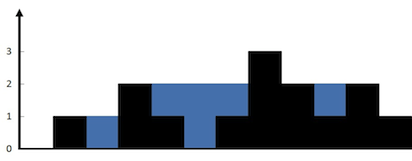
Input: height = [0,1,0,2,1,0,1,3,2,1,2,1]
Output: 6
Explanation: The above elevation map (black section) is represented by array [0,1,0,2,1,0,1,3,2,1,2,1]. In this case, 6 units of rain water (blue section) are being trapped.
Example 2:
Input: height = [4,2,0,3,2,5]
Output: 9
Constraints:
n == height.length1 <= n <= 2 * 1040 <= height[i] <= 105
Approaches
3 approaches with complexity analysis and trade-offs.
This is the most straightforward approach. For each bar, we find the highest bar on its left and its right. The amount of water that can be trapped above the current bar is the minimum of these two heights minus the current bar's height.
Algorithm
- Initialize a variable
totalWaterto 0. - Iterate through the
heightarray from the second element to the second-to-last element (indices1ton-2). Let the current index bei. - For each index
i:- Find the maximum height to the left of
i(includingi). Iterate from index0toiand findmaxLeft. - Find the maximum height to the right of
i(includingi). Iterate from indexiton-1and findmaxRight. - The water that can be trapped at index
iismin(maxLeft, maxRight) - height[i]. - If this value is positive, add it to
totalWater.
- Find the maximum height to the left of
- Return
totalWater.
Walkthrough
The core idea is that the water trapped at any position i is determined by the walls around it. Specifically, it's min(max_left_height, max_right_height) - height[i]. In this approach, we iterate through each bar of the elevation map (excluding the first and last, as they cannot trap water by themselves). For each bar at index i, we perform two additional scans: one to find the maximum height of all bars to its left (including itself), and another to find the maximum height of all bars to its right (including itself). The water level at position i is limited by the lower of these two maximums. We calculate the trapped water at i and add it to a running total.
class Solution { public int trap(int[] height) { if (height == null || height.length == 0) { return 0; } int n = height.length; int totalWater = 0; // Iterate through each bar from index 1 to n-2 for (int i = 1; i < n - 1; i++) { // Find the maximum height to the left of the current bar int maxLeft = 0; for (int j = i; j >= 0; j--) { maxLeft = Math.max(maxLeft, height[j]); } // Find the maximum height to the right of the current bar int maxRight = 0; for (int j = i; j < n; j++) { maxRight = Math.max(maxRight, height[j]); } // Water trapped at current bar is min(maxLeft, maxRight) - height[i] totalWater += Math.min(maxLeft, maxRight) - height[i]; } return totalWater; }}Complexity
Time
O(n^2)
Space
O(1)
Trade-offs
Pros
Simple to understand and implement.
Uses constant extra space.
Cons
Highly inefficient due to repeated calculations for
maxLeftandmaxRightfor each bar.Likely to result in a 'Time Limit Exceeded' error on larger test cases.
Solutions
Solution
public class Solution { public int Trap ( int [] height ) { int n = height . Length ; int [] left = new int [ n ]; int [] right = new int [ n ]; left [ 0 ] = height [ 0 ]; right [ n - 1 ] = height [ n - 1 ]; for ( int i = 1 ; i < n ; ++ i ) { left [ i ] = Math . Max ( left [ i - 1 ], height [ i ]); right [ n - i - 1 ] = Math . Max ( right [ n - i ], height [ n - i - 1 ]); } int ans = 0 ; for ( int i = 0 ; i < n ; ++ i ) { ans += Math . Min ( left [ i ], right [ i ]) - height [ i ]; } return ans ; } }Video walkthrough
Newsletter
One sharp idea, every week
System design and interview prep — short enough to finish.
No spam. Unsubscribe anytime.
Practice
Same difficulty — related problems to reinforce the pattern.