
Valid Sudoku
MedPrompt
Determine if a 9 x 9 Sudoku board is valid. Only the filled cells need to be validated according to the following rules:
- Each row must contain the digits
1-9without repetition. - Each column must contain the digits
1-9without repetition. - Each of the nine
3 x 3sub-boxes of the grid must contain the digits1-9without repetition.
Note:
- A Sudoku board (partially filled) could be valid but is not necessarily solvable.
- Only the filled cells need to be validated according to the mentioned rules.
Example 1:
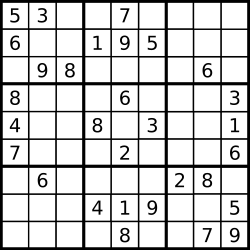
Input: board =
[["5","3",".",".","7",".",".",".","."]
,["6",".",".","1","9","5",".",".","."]
,[".","9","8",".",".",".",".","6","."]
,["8",".",".",".","6",".",".",".","3"]
,["4",".",".","8",".","3",".",".","1"]
,["7",".",".",".","2",".",".",".","6"]
,[".","6",".",".",".",".","2","8","."]
,[".",".",".","4","1","9",".",".","5"]
,[".",".",".",".","8",".",".","7","9"]]
Output: true
Example 2:
Input: board =
[["8","3",".",".","7",".",".",".","."]
,["6",".",".","1","9","5",".",".","."]
,[".","9","8",".",".",".",".","6","."]
,["8",".",".",".","6",".",".",".","3"]
,["4",".",".","8",".","3",".",".","1"]
,["7",".",".",".","2",".",".",".","6"]
,[".","6",".",".",".",".","2","8","."]
,[".",".",".","4","1","9",".",".","5"]
,[".",".",".",".","8",".",".","7","9"]]
Output: false
Explanation: Same as Example 1, except with the 5 in the top left corner being modified to 8. Since there are two 8's in the top left 3x3 sub-box, it is invalid.
Constraints:
board.length == 9board[i].length == 9board[i][j]is a digit1-9or'.'.
Approaches
3 approaches with complexity analysis and trade-offs.
This approach improves upon the brute-force method by validating all rows, then all columns, and finally all 3x3 sub-boxes in separate phases. This avoids the redundant checks of the previous method.
Algorithm
- Validate Rows:
- For each row
ifrom 0 to 8:- Use a
HashSetto track seen digits. - Iterate through the row. If a digit is already in the set, return
false. Otherwise, add it.
- Use a
- For each row
- Validate Columns:
- For each column
jfrom 0 to 8:- Use a new
HashSet. - Iterate through the column. If a digit is already in the set, return
false. Otherwise, add it.
- Use a new
- For each column
- Validate Sub-boxes:
- For each of the 9 sub-boxes:
- Use a new
HashSet. - Iterate through the 3x3 cells of the box. If a digit is already in the set, return
false. Otherwise, add it.
- Use a new
- For each of the 9 sub-boxes:
- If all checks pass, return
true.
Walkthrough
The validation is split into three distinct parts:
- Row Validation: Iterate through each of the 9 rows. For each row, use a
HashSet(or a boolean array) to keep track of the digits encountered. If a digit is seen more than once in the same row, the board is invalid. - Column Validation: Similarly, iterate through each of the 9 columns. Use a fresh
HashSetfor each column to check for duplicate digits. - Sub-box Validation: Iterate through each of the 9 3x3 sub-boxes. A
HashSetis used for each sub-box to ensure no digit is repeated within it. The sub-boxes can be traversed by iterating their top-left corners, e.g.,(0,0), (0,3), (0,6), .... If all three validation phases complete successfully, the board is valid. This method processes each cell three times in total.
import java.util.HashSet;import java.util.Set; class Solution { public boolean isValidSudoku(char[][] board) { // Check rows for (int i = 0; i < 9; i++) { Set<Character> seen = new HashSet<>(); for (int j = 0; j < 9; j++) { char current = board[i][j]; if (current != '.') { if (seen.contains(current)) { return false; } seen.add(current); } } } // Check columns for (int j = 0; j < 9; j++) { Set<Character> seen = new HashSet<>(); for (int i = 0; i < 9; i++) { char current = board[i][j]; if (current != '.') { if (seen.contains(current)) { return false; } seen.add(current); } } } // Check 3x3 sub-boxes for (int boxRow = 0; boxRow < 3; boxRow++) { for (int boxCol = 0; boxCol < 3; boxCol++) { Set<Character> seen = new HashSet<>(); int startRow = boxRow * 3; int startCol = boxCol * 3; for (int i = startRow; i < startRow + 3; i++) { for (int j = startCol; j < startCol + 3; j++) { char current = board[i][j]; if (current != '.') { if (seen.contains(current)) { return false; } seen.add(current); } } } } } return true; }}Complexity
Time
O(N^2)
Space
O(N)
Trade-offs
Pros
Much more efficient than brute force with O(N^2) time complexity.
Code is well-structured and easy to follow.
Space efficient, using O(N) extra space.
Cons
Iterates over the board three times, which can be slightly less performant than a single-pass approach due to loop overhead and potentially worse cache performance.
Solutions
Solution
class Solution { public boolean isValidSudoku ( char [][] board ) { boolean [][] row = new boolean [ 9 ][ 9 ]; boolean [][] col = new boolean [ 9 ][ 9 ]; boolean [][] sub = new boolean [ 9 ][ 9 ]; for ( int i = 0 ; i < 9 ; ++ i ) { for ( int j = 0 ; j < 9 ; ++ j ) { char c = board [ i ][ j ]; if ( c == '.' ) { continue ; } int num = c - '0' - 1 ; int k = i / 3 * 3 + j / 3 ; if ( row [ i ][ num ] || col [ j ][ num ] || sub [ k ][ num ]) { return false ; } row [ i ][ num ] = true ; col [ j ][ num ] = true ; sub [ k ][ num ] = true ; } } return true ; } }Video walkthrough
Newsletter
One sharp idea, every week
System design and interview prep — short enough to finish.
No spam. Unsubscribe anytime.
Practice
Same difficulty — related problems to reinforce the pattern.