
Validate Binary Tree Nodes
MedPrompt
You have n binary tree nodes numbered from 0 to n - 1 where node i has two children leftChild[i] and rightChild[i], return true if and only if all the given nodes form exactly one valid binary tree.
If node i has no left child then leftChild[i] will equal -1, similarly for the right child.
Note that the nodes have no values and that we only use the node numbers in this problem.
Example 1:
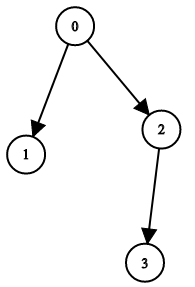
Input: n = 4, leftChild = [1,-1,3,-1], rightChild = [2,-1,-1,-1]
Output: true
Example 2:
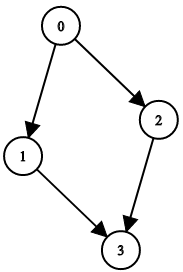
Input: n = 4, leftChild = [1,-1,3,-1], rightChild = [2,3,-1,-1]
Output: false
Example 3:
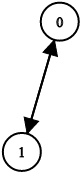
Input: n = 2, leftChild = [1,0], rightChild = [-1,-1]
Output: false
Constraints:
n == leftChild.length == rightChild.length1 <= n <= 104-1 <= leftChild[i], rightChild[i] <= n - 1
Approaches
2 approaches with complexity analysis and trade-offs.
This approach uses a Union-Find (DSU) data structure to detect cycles and ensure all nodes form a single connected component. It also separately verifies the parent-child rules of a binary tree, namely that each node has at most one parent.
Algorithm
- Initialize a Union-Find (DSU) data structure with
ncomponents, one for each node. - Initialize an
inDegreearray of sizento all zeros to track the number of parents for each node. - Iterate through each node
pfrom0ton-1. - For each child
c(leftChild[p]orrightChild[p]):- If
cis not-1:- If
calready has a parent (inDegree[c] == 1), it violates the binary tree property. Returnfalse. - If
pandcare already in the same connected component (find(p) == find(c)), adding the edgep -> cwould create a cycle. Returnfalse. - If the checks pass, increment
inDegree[c]and performunion(p, c)to merge their sets.
- If
- If
- After iterating through all nodes, we must have exactly one connected component and exactly one root.
- The number of components in the DSU must be 1.
- The number of nodes with an in-degree of 0 (roots) must be 1.
- If both conditions hold, return
true; otherwise, returnfalse.
Walkthrough
A valid binary tree must be a single connected component, contain no cycles, and every node (except the root) must have exactly one parent. This approach tackles these conditions using a combination of an in-degree count and a DSU data structure.
-
Parent Uniqueness: We use an
inDegreearray to track the number of parents for each node. As we process theleftChildandrightChildarrays, we check the child's in-degree. If a child node is about to be assigned a second parent, we immediately know the structure is invalid. -
Cycle Detection & Connectivity: A DSU data structure is initialized with
nnodes, each in its own set. For each parent-child relationshipp -> c, we first check for parent uniqueness. Then, we check ifpandcare already in the same set using thefindoperation. If they are, it implies that an undirected path already exists between them. Sincechas no other parent, this must meancis an ancestor ofp, so adding the edgep -> cwould form a cycle. If no cycle is formed, weunionthem, merging their sets and decrementing the component count. -
Final Validation: After processing all edges, a valid tree must consist of a single component with a single root. We check that the final number of components in the DSU is 1 and that the number of nodes with an in-degree of 0 is also exactly 1.
class Solution { class DSU { private int[] parent; private int components; public DSU(int n) { parent = new int[n]; components = n; for (int i = 0; i < n; i++) { parent[i] = i; } } public int find(int i) { if (parent[i] == i) { return i; } return parent[i] = find(parent[i]); } public boolean union(int i, int j) { int rootI = find(i); int rootJ = find(j); if (rootI != rootJ) { parent[rootJ] = rootI; components--; return true; } return false; } public int getComponents() { return components; } } public boolean validateBinaryTreeNodes(int n, int[] leftChild, int[] rightChild) { DSU dsu = new DSU(n); int[] inDegree = new int[n]; for (int i = 0; i < n; i++) { int lc = leftChild[i]; int rc = rightChild[i]; if (lc != -1) { if (inDegree[lc] > 0) return false; // Already has a parent if (dsu.find(i) == dsu.find(lc)) return false; // Cycle dsu.union(i, lc); inDegree[lc]++; } if (rc != -1) { if (inDegree[rc] > 0) return false; // Already has a parent if (dsu.find(i) == dsu.find(rc)) return false; // Cycle dsu.union(i, rc); inDegree[rc]++; } } int rootCount = 0; for (int i = 0; i < n; i++) { if (inDegree[i] == 0) { rootCount++; } } return rootCount == 1 && dsu.getComponents() == 1; }}Complexity
Time
O(N * α(N)), where N is the number of nodes and α is the Inverse Ackermann function. The main loop runs N times, and each union/find operation is nearly constant time.
Space
O(N) to store the DSU's parent array and the in-degree array.
Trade-offs
Pros
Provides a structured way to check for connectivity and cycles simultaneously.
Union-Find is a standard, efficient data structure for problems involving disjoint sets.
Cons
More complex to implement correctly compared to a simple traversal.
The logic combines multiple concepts (in-degrees, DSU for cycles, DSU for components), making it less straightforward.
Can be slightly less performant in practice due to the overhead of the DSU data structure.
Solutions
Solution
class Solution {private int[] p;public boolean validateBinaryTreeNodes(int n, int[] leftChild, int[] rightChild) { p = new int[n]; for (int i = 0; i < n; ++i) { p[i] = i; } boolean[] vis = new boolean[n]; for (int i = 0, m = n; i < m; ++i) { for (int j : new int[]{leftChild[i], rightChild[i]}) { if (j != -1) { if (vis[j] || find(i) == find(j)) { return false; } p[find(i)] = find(j); vis[j] = true; --n; } } } return n == 1; }private int find(int x) { if (p[x] != x) { p[x] = find(p[x]); } return p[x]; }}Video walkthrough
Newsletter
One sharp idea, every week
System design and interview prep — short enough to finish.
No spam. Unsubscribe anytime.
Practice
Same difficulty — related problems to reinforce the pattern.