
Where Will the Ball Fall
MedPrompt
You have a 2-D grid of size m x n representing a box, and you have n balls. The box is open on the top and bottom sides.
Each cell in the box has a diagonal board spanning two corners of the cell that can redirect a ball to the right or to the left.
- A board that redirects the ball to the right spans the top-left corner to the bottom-right corner and is represented in the grid as
1. - A board that redirects the ball to the left spans the top-right corner to the bottom-left corner and is represented in the grid as
-1.
We drop one ball at the top of each column of the box. Each ball can get stuck in the box or fall out of the bottom. A ball gets stuck if it hits a "V" shaped pattern between two boards or if a board redirects the ball into either wall of the box.
Return an array answer of size n where answer[i] is the column that the ball falls out of at the bottom after dropping the ball from the ith column at the top, or -1 if the ball gets stuck in the box.
Example 1:
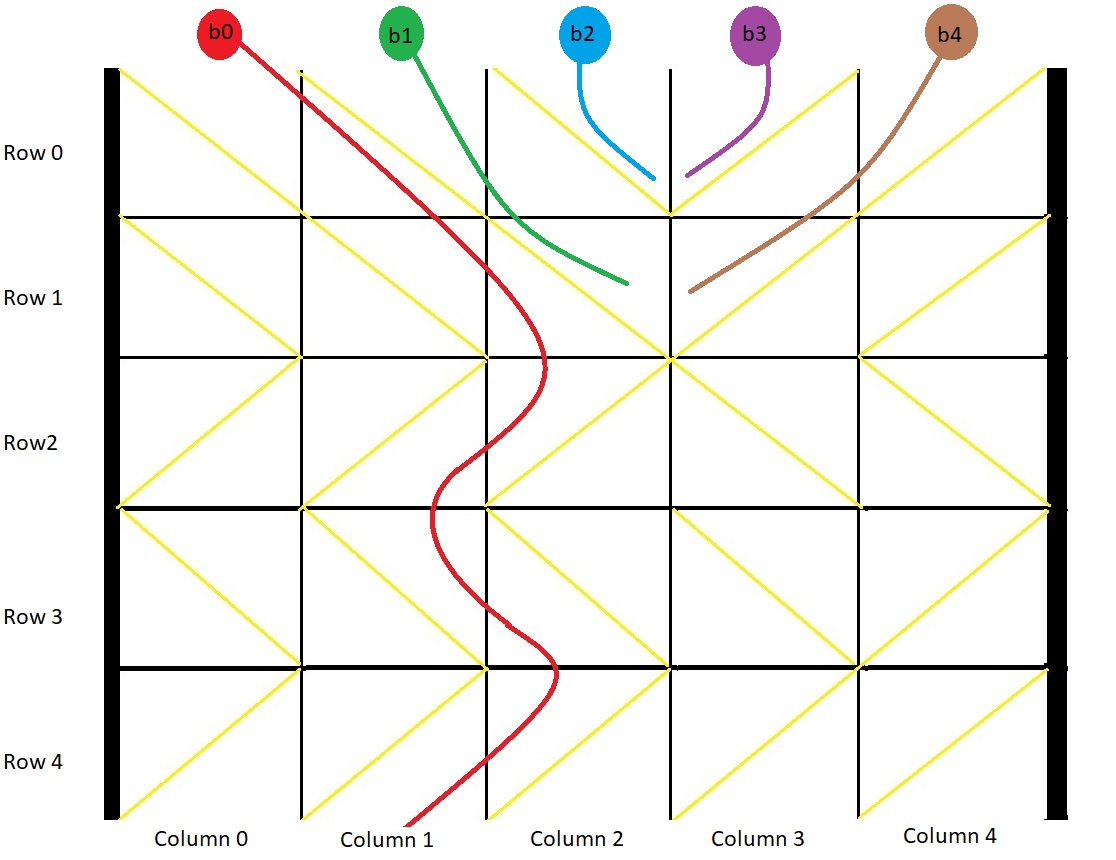
Input: grid = [[1,1,1,-1,-1],[1,1,1,-1,-1],[-1,-1,-1,1,1],[1,1,1,1,-1],[-1,-1,-1,-1,-1]]
Output: [1,-1,-1,-1,-1]
Explanation: This example is shown in the photo.
Ball b0 is dropped at column 0 and falls out of the box at column 1.
Ball b1 is dropped at column 1 and will get stuck in the box between column 2 and 3 and row 1.
Ball b2 is dropped at column 2 and will get stuck on the box between column 2 and 3 and row 0.
Ball b3 is dropped at column 3 and will get stuck on the box between column 2 and 3 and row 0.
Ball b4 is dropped at column 4 and will get stuck on the box between column 2 and 3 and row 1.
Example 2:
Input: grid = [[-1]]
Output: [-1]
Explanation: The ball gets stuck against the left wall.
Example 3:
Input: grid = [[1,1,1,1,1,1],[-1,-1,-1,-1,-1,-1],[1,1,1,1,1,1],[-1,-1,-1,-1,-1,-1]]
Output: [0,1,2,3,4,-1]
Constraints:
m == grid.lengthn == grid[i].length1 <= m, n <= 100grid[i][j]is1or-1.
Approaches
2 approaches with complexity analysis and trade-offs.
This approach simulates the path of each ball using a recursive function. For each ball dropped at the top of a column, a recursive function traces its path downwards, row by row. The function checks for conditions that would cause the ball to get stuck at each step. If the ball successfully reaches the bottom, the function returns its final column; otherwise, it returns -1.
Algorithm
- Create an integer array
answerof sizen. - Loop through each column
ifrom0ton-1. - For each
i, call a recursive helper functionfindPath(0, i, grid). - Store the result of the helper function in
answer[i]. - The
findPath(row, col, grid)function:- a. If
rowequals the number of rowsm, it means the ball has passed through. Returncol. - b. Calculate
nextCol = col + grid[row][col]. - c. If
nextColis out of bounds (< 0or>= n) or ifgrid[row][col]is not equal togrid[row][nextCol](forming a 'V' shape), the ball is stuck. Return-1. - d. Otherwise, the ball continues to the next row. Return the result of
findPath(row + 1, nextCol, grid).
- a. If
- After the loop, return the
answerarray.
Walkthrough
We define a helper function, say findBallDropColumn(row, col), which simulates the ball's path starting from (row, col). The main function iterates through each starting column i from 0 to n-1 and calls this helper function with findBallDropColumn(0, i). The results are collected into an answer array.
The findBallDropColumn function works as follows:
- Base Case: If the current
rowis equal tom(the total number of rows), it means the ball has successfully fallen through the bottom of the box. We return the currentcol. - Stuck Conditions: We determine the direction of deflection
direction = grid[row][col]and calculate the next columnnextCol = col + direction. We then check for two stuck conditions:- Wall Collision: If
nextColis out of bounds (less than 0 or greater than or equal ton), the ball is stuck. Return-1. - "V" Shape Trap: If the board in the adjacent cell
grid[row][nextCol]has an opposing direction (grid[row][nextCol] != direction), the ball is stuck. Return-1.
- Wall Collision: If
- Recursive Step: If the ball is not stuck, it moves to the next row at the new column. We make a recursive call:
findBallDropColumn(row + 1, nextCol).
class Solution { public int[] findBall(int[][] grid) { int m = grid.length; int n = grid[0].length; int[] answer = new int[n]; for (int i = 0; i < n; i++) { answer[i] = findBallDropColumn(0, i, grid); } return answer; } private int findBallDropColumn(int row, int col, int[][] grid) { // Base case: Ball has fallen out of the bottom. if (row == grid.length) { return col; } int nextCol = col + grid[row][col]; // Check for stuck conditions // 1. Hits a wall if (nextCol < 0 || nextCol >= grid[0].length) { return -1; } // 2. Forms a 'V' shape if (grid[row][col] != grid[row][nextCol]) { return -1; } // Recursive step: move to the next row return findBallDropColumn(row + 1, nextCol, grid); }}Complexity
Time
O(m * n). For each of the `n` balls, the simulation involves traversing `m` rows. The recursion depth is `m`, and each recursive call takes constant time.
Space
O(m). The recursion can go up to a depth of `m` (the number of rows), so the function call stack will use O(m) space. This is in addition to the O(n) space for the output array.
Trade-offs
Pros
The code can be very clean and closely mirrors the problem's logic of a ball moving from one state (row) to the next.
It's a natural way to think about path-finding problems.
Cons
Can lead to a
StackOverflowErrorfor very largem, although the problem constraints (m <= 100) make this unlikely.Generally less space-efficient than an iterative solution due to the overhead of the function call stack.
This approach simulates the path of each ball using nested loops. The outer loop iterates through each ball, and the inner loop simulates its journey downwards through the rows of the grid. This avoids recursion and its associated overhead, making it more space-efficient.
Algorithm
- Create an integer array
answerof sizen. - Loop through each starting column
ifrom0ton-1. - Initialize a variable
currentCol = ito track the ball's column. - Loop through each row
rfrom0tom-1.- a. Calculate the next potential column:
nextCol = currentCol + grid[r][currentCol]. - b. Check for stuck conditions: if
nextColis out of bounds (< 0or>= n) or if a 'V' shape is formed (grid[r][currentCol] != grid[r][nextCol]), the ball is stuck. SetcurrentCol = -1and break the inner loop over rows. - c. If the move is valid, update
currentCol = nextCol.
- a. Calculate the next potential column:
- After the inner loop finishes, assign the final value of
currentColtoanswer[i]. - After the outer loop completes, return the
answerarray.
Walkthrough
We initialize an answer array of size n to store the results. We then iterate through each starting column i from 0 to n-1. For each i, we trace the path of one ball.
We use a variable, currentCol, initialized to i, to keep track of the ball's current column position. We then start an inner loop that iterates through each row r from 0 to m-1.
Inside the inner loop, for each cell (r, currentCol), we determine the ball's next move.
- Let
direction = grid[r][currentCol]. - The ball intends to move to
nextCol = currentCol + direction. - We check for the two stuck conditions:
- Wall Collision:
nextColis out of bounds (< 0or>= n). - "V" Shape Trap: The adjacent board
grid[r][nextCol]has an opposing direction (grid[r][nextCol] != direction).
- Wall Collision:
- If either condition is met, the ball is stuck. We set
currentColto-1and break out of the inner (row) loop. - If the move is valid, we update
currentColtonextColand continue to the next row.
After the inner loop finishes (either by completing all rows or breaking early), the final value of currentCol (which is either the exit column or -1) is stored in answer[i]. After the outer loop completes, the answer array is returned.
class Solution { public int[] findBall(int[][] grid) { int m = grid.length; int n = grid[0].length; int[] answer = new int[n]; for (int i = 0; i < n; i++) { int currentCol = i; for (int r = 0; r < m; r++) { int nextCol = currentCol + grid[r][currentCol]; // Check for stuck conditions if (nextCol < 0 || nextCol >= n || grid[r][currentCol] != grid[r][nextCol]) { currentCol = -1; // Ball is stuck break; } // Move to the next column for the next row currentCol = nextCol; } answer[i] = currentCol; } return answer; }}Complexity
Time
O(m * n). We have two nested loops. The outer loop runs `n` times (for each ball), and the inner loop runs `m` times (for each row). The operations inside the inner loop are constant time.
Space
O(1) auxiliary space. We only use a few variables to track the state of the current ball. The O(n) space for the output array is typically not counted as extra space.
Trade-offs
Pros
More space-efficient than the recursive approach as it avoids the overhead of the function call stack.
No risk of
StackOverflowError, making it more robust for deep grids.The logic is straightforward and easy to follow for those more comfortable with iterative solutions.
Cons
The code might be slightly more verbose than a compact recursive solution, requiring explicit state management with a loop variable.
Solutions
Solution
class Solution {private int m;private int n;private int[][] grid;public int[] findBall(int[][] grid) { m = grid.length; n = grid[0].length; this.grid = grid; int[] ans = new int[n]; for (int j = 0; j < n; ++j) { ans[j] = dfs(0, j); } return ans; }private int dfs(int i, int j) { if (i == m) { return j; } if (j == 0 && grid[i][j] == -1) { return -1; } if (j == n - 1 && grid[i][j] == 1) { return -1; } if (grid[i][j] == 1 && grid[i][j + 1] == -1) { return -1; } if (grid[i][j] == -1 && grid[i][j - 1] == 1) { return -1; } return grid[i][j] == 1 ? dfs(i + 1, j + 1) : dfs(i + 1, j - 1); }}/** * @param {number[][]} grid * @return {number[]} */ var findBall = function ( grid,) { const m = grid.length; const n = grid[0].length; const dfs = (i, j) => { if (i === m) { return j; } if (grid[i][j] === 1) { if (j === n - 1 || grid[i][j + 1] === -1) { return -1; } return dfs(i + 1, j + 1); } else { if (j === 0 || grid[i][j - 1] === 1) { return -1; } return dfs(i + 1, j - 1); } }; return Array.from({ length: n }, (_, j) => dfs(0, j));};class Solution {public: vector<int> findBall(vector<vector<int>> &grid) { int m = grid.size(), n = grid[0].size(); vector<int> ans(n); function<int(int, int)> dfs = [&](int i, int j) { if (i == m) { return j; } if (j == 0 && grid[i][j] == -1) { return -1; } if (j == n - 1 && grid[i][j] == 1) { return -1; } if (grid[i][j] == 1 && grid[i][j + 1] == -1) { return -1; } if (grid[i][j] == -1 && grid[i][j - 1] == 1) { return -1; } return grid[i][j] == 1 ? dfs(i + 1, j + 1) : dfs(i + 1, j - 1); }; for (int j = 0; j < n; ++j) { ans[j] = dfs(0, j); } return ans; }};class Solution : def findBall ( self , grid : List [ List [ int ]]) -> List [ int ]: def dfs ( i : int , j : int ) -> int : if i == m : return j if j == 0 and grid [ i ][ j ] == - 1 : return - 1 if j == n - 1 and grid [ i ][ j ] == 1 : return - 1 if grid [ i ][ j ] == 1 and grid [ i ][ j + 1 ] == - 1 : return - 1 if grid [ i ][ j ] == - 1 and grid [ i ][ j - 1 ] == 1 : return - 1 return dfs ( i + 1 , j + 1 ) if grid [ i ][ j ] == 1 else dfs ( i + 1 , j - 1 ) m , n = len ( grid ), len ( grid [ 0 ]) return [ dfs ( 0 , j ) for j in range ( n )]Video walkthrough
Newsletter
One sharp idea, every week
System design and interview prep — short enough to finish.
No spam. Unsubscribe anytime.
Practice
Same difficulty — related problems to reinforce the pattern.