
Binary Tree Level Order Traversal II
MedPrompt
Given the root of a binary tree, return the bottom-up level order traversal of its nodes' values. (i.e., from left to right, level by level from leaf to root).
Example 1:
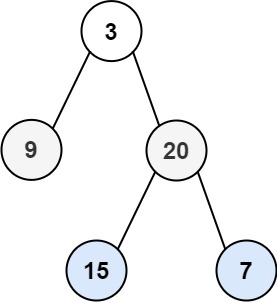
Input: root = [3,9,20,null,null,15,7]
Output: [[15,7],[9,20],[3]]
Example 2:
Input: root = [1]
Output: [[1]]
Example 3:
Input: root = []
Output: []
Constraints:
- The number of nodes in the tree is in the range
[0, 2000]. -1000 <= Node.val <= 1000
Approaches
3 approaches with complexity analysis and trade-offs.
This approach uses a recursive Depth-First Search (DFS) to traverse the tree. It keeps track of the level of each node to group them correctly. The levels are gathered in a top-down order, and the final list of levels is reversed to achieve the required bottom-up order.
Algorithm
- Initialize an empty list of lists,
result. - If the root is
null, return the emptyresult. - Create a recursive helper function,
dfs(node, level, result). - Call the helper function with the root, level 0, and the
resultlist. - Inside the helper function:
- Base case: if the node is
null, return. - If
levelis equal toresult.size(), it's the first time we're visiting this level. Add a new empty list toresult. - Add the node's value to the list at index
level:result.get(level).add(node.val). - Recursively call for the left child:
dfs(node.left, level + 1, result). - Recursively call for the right child:
dfs(node.right, level + 1, result).
- Base case: if the node is
- After the initial DFS call returns, the
resultlist contains the levels in top-down order. - Reverse the
resultlist usingCollections.reverse(). - Return the reversed list.
Walkthrough
We can perform a pre-order traversal on the tree while keeping track of the current level. We use a list of lists, result, to store the nodes for each level. The level variable acts as an index into this result list. When we visit a node at a level for the first time, we add a new list to result. Then, we add the node's value to the list corresponding to its level. After the traversal is complete, result will hold the levels from top to bottom. The final step is to reverse this result list to get the bottom-up order.
/** * Definition for a binary tree node. * public class TreeNode { * int val; * TreeNode left; * TreeNode right; * TreeNode() {} * TreeNode(int val) { this.val = val; } * TreeNode(int val, TreeNode left, TreeNode right) { * this.val = val; * this.left = left; * this.right = right; * } * } */class Solution { public List<List<Integer>> levelOrderBottom(TreeNode root) { List<List<Integer>> result = new ArrayList<>(); if (root == null) { return result; } dfs(root, 0, result); Collections.reverse(result); return result; } private void dfs(TreeNode node, int level, List<List<Integer>> result) { if (node == null) { return; } // If we are visiting a new level, add a new list for it. if (level >= result.size()) { result.add(new ArrayList<>()); } // Add the node's value to the list for its level. result.get(level).add(node.val); // Recurse for children. dfs(node.left, level + 1, result); dfs(node.right, level + 1, result); }}Complexity
Time
O(N)
Space
O(N)
Trade-offs
Pros
Conceptually simple if one is familiar with DFS and recursion.
Follows a standard tree traversal pattern.
Cons
Requires an extra step to reverse the final list.
The recursive approach can lead to a
StackOverflowErrorfor very deep or skewed trees.The space complexity for the recursion stack is O(H), where H is the tree height, which can be O(N) for a skewed tree.
Solutions
Solution
/** * Definition for a binary tree node. * public class TreeNode { * int val; * TreeNode left; * TreeNode right; * TreeNode() {} * TreeNode(int val) { this.val = val; } * TreeNode(int val, TreeNode left, TreeNode right) { * this.val = val; * this.left = left; * this.right = right; * } * } */ class Solution { public List < List < Integer >> levelOrderBottom ( TreeNode root ) { LinkedList < List < Integer >> ans = new LinkedList <>(); if ( root == null ) { return ans ; } Deque < TreeNode > q = new LinkedList <>(); q . offerLast ( root ); while (! q . isEmpty ()) { List < Integer > t = new ArrayList <>(); for ( int i = q . size (); i > 0 ; -- i ) { TreeNode node = q . pollFirst (); t . add ( node . val ); if ( node . left != null ) { q . offerLast ( node . left ); } if ( node . right != null ) { q . offerLast ( node . right ); } } ans . addFirst ( t ); } return ans ; } }Video walkthrough
Newsletter
One sharp idea, every week
System design and interview prep — short enough to finish.
No spam. Unsubscribe anytime.
Practice
Same difficulty — related problems to reinforce the pattern.