
Check if There is a Valid Path in a Grid
MedPrompt
You are given an m x n grid. Each cell of grid represents a street. The street of grid[i][j] can be:
1which means a street connecting the left cell and the right cell.2which means a street connecting the upper cell and the lower cell.3which means a street connecting the left cell and the lower cell.4which means a street connecting the right cell and the lower cell.5which means a street connecting the left cell and the upper cell.6which means a street connecting the right cell and the upper cell.
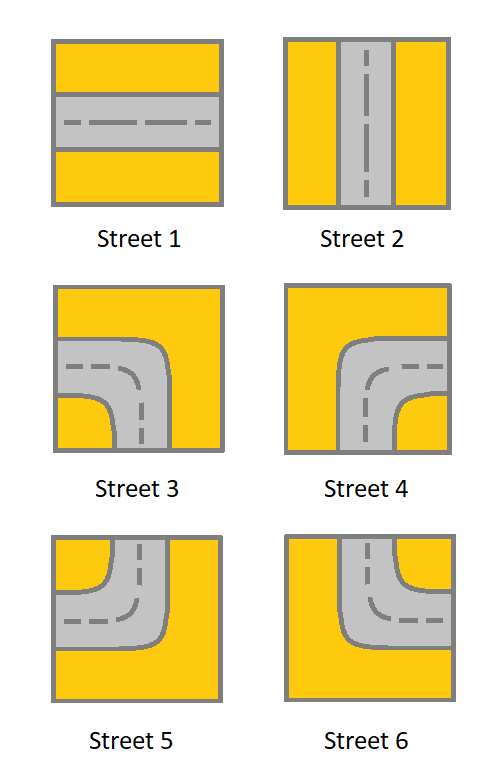
You will initially start at the street of the upper-left cell (0, 0). A valid path in the grid is a path that starts from the upper left cell (0, 0) and ends at the bottom-right cell (m - 1, n - 1). The path should only follow the streets.
Notice that you are not allowed to change any street.
Return true if there is a valid path in the grid or false otherwise.
Example 1:
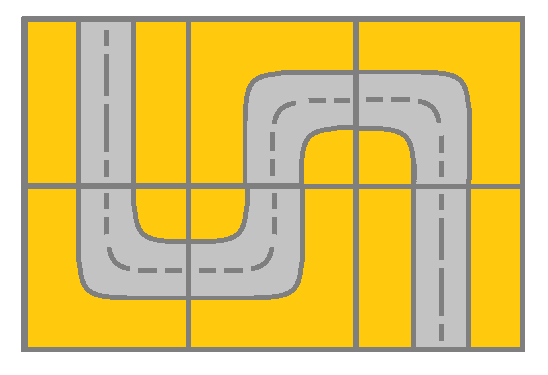
Input: grid = [[2,4,3],[6,5,2]]
Output: true
Explanation: As shown you can start at cell (0, 0) and visit all the cells of the grid to reach (m - 1, n - 1).
Example 2:
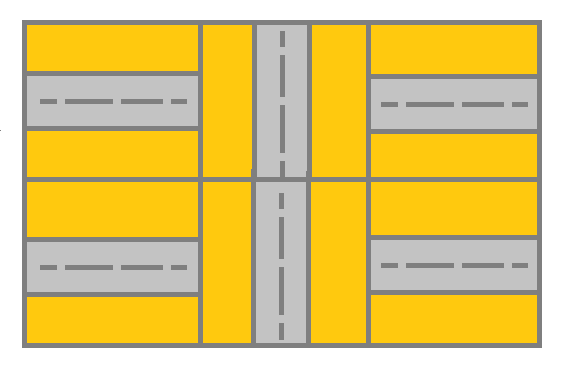
Input: grid = [[1,2,1],[1,2,1]]
Output: false
Explanation: As shown you the street at cell (0, 0) is not connected with any street of any other cell and you will get stuck at cell (0, 0)
Example 3:
Input: grid = [[1,1,2]]
Output: false
Explanation: You will get stuck at cell (0, 1) and you cannot reach cell (0, 2).
Constraints:
m == grid.lengthn == grid[i].length1 <= m, n <= 3001 <= grid[i][j] <= 6
Approaches
3 approaches with complexity analysis and trade-offs.
This approach models the grid as a graph where each cell is a node. An edge exists between two adjacent cells if their respective streets connect to each other. The problem then becomes finding if a path exists from the source node (0, 0) to the destination node (m-1, n-1). DFS is a natural way to explore this path.
Algorithm
- We model the grid as a graph where each cell is a node. An edge exists between two adjacent cells if their respective streets connect to each other. The problem then becomes finding if a path exists from the source node (0, 0) to the destination node (m-1, n-1).
- We start a traversal from the cell (0, 0).
- We use a
visitedboolean grid to keep track of cells that are already part of the current exploration path to avoid cycles and redundant computations. - The core of the approach is a recursive function, say
dfs(row, col), which explores paths from the current cell(row, col). - Algorithm Steps:
- Define the possible moves for each street type. A street
kallows moves in two directions. We can store this in a 3D array, e.g.,moves[k-1] = {{dr1, dc1}, {dr2, dc2}}. - Create a recursive function
dfs(r, c, grid, visited). - Base Case: If
(r, c)is the destination(m-1, n-1), a path is found, returntrue. - Mark the current cell
(r, c)as visited. - Get the current street type
type = grid[r][c]. - Iterate through the two possible moves
(dr, dc)for thistype. - For each move, calculate the neighbor's coordinates
(nr, nc) = (r + dr, c + dc). - Validity Checks:
- Check if
(nr, nc)is within the grid boundaries. - Check if
(nr, nc)has been visited. - Crucially, check if the street at
(nr, nc)connects back to(r, c). This means one of the allowed moves from(nr, nc)must be(-dr, -dc).
- Check if
- If the move is valid, make a recursive call
dfs(nr, nc, grid, visited). If this call returnstrue, it means a path to the destination was found, so propagatetrueup the call stack. - The initial call is
dfs(0, 0, grid, visited).
- Define the possible moves for each street type. A street
Walkthrough
class Solution { // directions[street_type - 1] = {{dr1, dc1}, {dr2, dc2}} private int[][][] directions = { {{0, -1}, {0, 1}}, // 1: left-right {{-1, 0}, {1, 0}}, // 2: up-down {{0, -1}, {1, 0}}, // 3: left-down {{0, 1}, {1, 0}}, // 4: right-down {{0, -1}, {-1, 0}}, // 5: left-up {{0, 1}, {-1, 0}} // 6: right-up }; private int m, n; private boolean[][] visited; public boolean hasValidPath(int[][] grid) { m = grid.length; n = grid[0].length; visited = new boolean[m][n]; return dfs(0, 0, grid); } private boolean dfs(int r, int c, int[][] grid) { if (r == m - 1 && c == n - 1) { return true; } visited[r][c] = true; int streetType = grid[r][c]; for (int[] dir : directions[streetType - 1]) { int nr = r + dir[0]; int nc = c + dir[1]; if (nr >= 0 && nr < m && nc >= 0 && nc < n && !visited[nr][nc]) { // Check if the next street connects back int nextStreetType = grid[nr][nc]; for (int[] backDir : directions[nextStreetType - 1]) { if (nr + backDir[0] == r && nc + backDir[1] == c) { if (dfs(nr, nc, grid)) { return true; } } } } } return false; }}Complexity
Time
O(m * n). In the worst case, we visit every cell in the grid once.
Space
O(m * n). This is for the `visited` array and the recursion stack. In the worst case, the recursion depth can be up to `m * n`.
Trade-offs
Pros
Conceptually straightforward and easy to implement.
Follows the problem's path-finding nature directly.
Cons
Can lead to a
StackOverflowErrorfor very large grids where the path is long and winding, as the recursion depth could exceed the stack limit.
Solutions
Solution
class Solution {private int[] p;private int[][] grid;private int m;private int n;public boolean hasValidPath(int[][] grid) { this.grid = grid; m = grid.length; n = grid[0].length; p = new int[m * n]; for (int i = 0; i < p.length; ++i) { p[i] = i; } for (int i = 0; i < m; ++i) { for (int j = 0; j < n; ++j) { int e = grid[i][j]; if (e == 1) { left(i, j); right(i, j); } else if (e == 2) { up(i, j); down(i, j); } else if (e == 3) { left(i, j); down(i, j); } else if (e == 4) { right(i, j); down(i, j); } else if (e == 5) { left(i, j); up(i, j); } else { right(i, j); up(i, j); } } } return find(0) == find(m * n - 1); }private int find(int x) { if (p[x] != x) { p[x] = find(p[x]); } return p[x]; }private void left(int i, int j) { if (j > 0 && (grid[i][j - 1] == 1 || grid[i][j - 1] == 4 || grid[i][j - 1] == 6)) { p[find(i * n + j)] = find(i * n + j - 1); } }private void right(int i, int j) { if (j < n - 1 && (grid[i][j + 1] == 1 || grid[i][j + 1] == 3 || grid[i][j + 1] == 5)) { p[find(i * n + j)] = find(i * n + j + 1); } }private void up(int i, int j) { if (i > 0 && (grid[i - 1][j] == 2 || grid[i - 1][j] == 3 || grid[i - 1][j] == 4)) { p[find(i * n + j)] = find((i - 1) * n + j); } }private void down(int i, int j) { if (i < m - 1 && (grid[i + 1][j] == 2 || grid[i + 1][j] == 5 || grid[i + 1][j] == 6)) { p[find(i * n + j)] = find((i + 1) * n + j); } }}Video walkthrough
Newsletter
One sharp idea, every week
System design and interview prep — short enough to finish.
No spam. Unsubscribe anytime.
Practice
Same difficulty — related problems to reinforce the pattern.