
Course Schedule IV
MedPrompt
There are a total of numCourses courses you have to take, labeled from 0 to numCourses - 1. You are given an array prerequisites where prerequisites[i] = [ai, bi] indicates that you must take course ai first if you want to take course bi.
- For example, the pair
[0, 1]indicates that you have to take course0before you can take course1.
Prerequisites can also be indirect. If course a is a prerequisite of course b, and course b is a prerequisite of course c, then course a is a prerequisite of course c.
You are also given an array queries where queries[j] = [uj, vj]. For the jth query, you should answer whether course uj is a prerequisite of course vj or not.
Return a boolean array answer, where answer[j] is the answer to the jth query.
Example 1:

Input: numCourses = 2, prerequisites = [[1,0]], queries = [[0,1],[1,0]]
Output: [false,true]
Explanation: The pair [1, 0] indicates that you have to take course 1 before you can take course 0.
Course 0 is not a prerequisite of course 1, but the opposite is true.
Example 2:
Input: numCourses = 2, prerequisites = [], queries = [[1,0],[0,1]]
Output: [false,false]
Explanation: There are no prerequisites, and each course is independent.
Example 3:
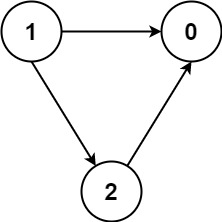
Input: numCourses = 3, prerequisites = [[1,2],[1,0],[2,0]], queries = [[1,0],[1,2]]
Output: [true,true]
Constraints:
2 <= numCourses <= 1000 <= prerequisites.length <= (numCourses * (numCourses - 1) / 2)prerequisites[i].length == 20 <= ai, bi <= numCourses - 1ai != bi- All the pairs
[ai, bi]are unique. - The prerequisites graph has no cycles.
1 <= queries.length <= 1040 <= ui, vi <= numCourses - 1ui != vi
Approaches
3 approaches with complexity analysis and trade-offs.
This approach treats each query independently. For every query [u, v], it performs a graph traversal, such as Breadth-First Search (BFS) or Depth-First Search (DFS), starting from the course u. The goal is to determine if course v is reachable from u. If v is encountered during the traversal, it means u is a prerequisite for v.
Algorithm
- Build an adjacency list
adjwhereadj.get(u)contains a list of coursesvfor whichuis a direct prerequisite. - Initialize an empty list
answerto store the boolean results. - For each query
[u, v]in thequeriesarray:- Perform a Breadth-First Search (BFS) or Depth-First Search (DFS) starting from node
uto check for reachability tov. - To perform BFS:
- Initialize a queue and add the starting course
u. - Use a
visitedboolean array to keep track of visited nodes for the current query to avoid redundant processing. - While the queue is not empty, dequeue a course
current. - If
currentis the target coursev, then a path exists. Addtrueto theanswerlist and break the search for this query. - Otherwise, for each
neighborofcurrentin the adjacency list, if the neighbor has not been visited, mark it as visited and enqueue it.
- Initialize a queue and add the starting course
- If the traversal completes without finding
v, it meansvis not reachable fromu. Addfalseto theanswerlist.
- Perform a Breadth-First Search (BFS) or Depth-First Search (DFS) starting from node
- Return the
answerlist.
Walkthrough
First, we represent the course prerequisites as a directed graph. An adjacency list is a suitable data structure, where adj[i] stores a list of courses that have i as a direct prerequisite.
The algorithm proceeds as follows:
- Construct the adjacency list from the
prerequisitesarray. - Initialize a list
answerto store the results of the queries. - Iterate through each query
[u, v]. - For the current query, start a BFS (or DFS) from node
u. A queue is used for BFS, and avisitedset is maintained to avoid redundant computations and handle the graph structure efficiently. - During the BFS, if we dequeue a node and it is the target node
v, we have found a path. This confirms thatuis a prerequisite forv. We addtrueto ouranswerlist and move to the next query. - If the BFS completes without finding
v, it means there is no path fromutov. In this case,uis not a prerequisite forv, and we addfalseto theanswerlist. - After processing all queries, return the
answerlist.
class Solution { public List<Boolean> checkIfPrerequisite(int numCourses, int[][] prerequisites, int[][] queries) { List<List<Integer>> adj = new ArrayList<>(); for (int i = 0; i < numCourses; i++) { adj.add(new ArrayList<>()); } for (int[] p : prerequisites) { adj.get(p[0]).add(p[1]); } List<Boolean> ans = new ArrayList<>(); for (int[] q : queries) { ans.add(isReachable(q[0], q[1], numCourses, adj)); } return ans; } private boolean isReachable(int startNode, int endNode, int n, List<List<Integer>> adj) { Queue<Integer> queue = new LinkedList<>(); boolean[] visited = new boolean[n]; queue.offer(startNode); visited[startNode] = true; while (!queue.isEmpty()) { int curr = queue.poll(); if (curr == endNode) { return true; } for (int neighbor : adj.get(curr)) { if (!visited[neighbor]) { visited[neighbor] = true; queue.offer(neighbor); } } } return false; }}Complexity
Time
O(Q * (N + P)), where Q is `queries.length`. For each of the Q queries, we perform a graph traversal (BFS/DFS) which takes O(N + P) time in the worst case.
Space
O(N + P), where N is `numCourses` and P is `prerequisites.length`. This space is used for storing the adjacency list. Each traversal also requires O(N) space for the queue and visited array.
Trade-offs
Pros
Conceptually simple and straightforward to implement.
Uses less memory than pre-computation approaches, which might be an advantage if memory is severely constrained and the number of queries is small.
Cons
Highly inefficient for a large number of queries, as it repeatedly traverses the same parts of the graph.
Very likely to cause a 'Time Limit Exceeded' (TLE) error on platforms with strict time limits due to its high time complexity.
Solutions
Solution
class Solution {public List<Boolean> checkIfPrerequisite(int n, int[][] prerequisites, int[][] queries) { boolean[][] f = new boolean[n][n]; for (var p : prerequisites) { f[p[0]][p[1]] = true; } for (int k = 0; k < n; ++k) { for (int i = 0; i < n; ++i) { for (int j = 0; j < n; ++j) { f[i][j] |= f[i][k] && f[k][j]; } } } List<Boolean> ans = new ArrayList<>(); for (var q : queries) { ans.add(f[q[0]][q[1]]); } return ans; }}Video walkthrough
Newsletter
One sharp idea, every week
System design and interview prep — short enough to finish.
No spam. Unsubscribe anytime.
Practice
Same difficulty — related problems to reinforce the pattern.