
Cherry Pickup II
HardPrompt
You are given a rows x cols matrix grid representing a field of cherries where grid[i][j] represents the number of cherries that you can collect from the (i, j) cell.
You have two robots that can collect cherries for you:
- Robot #1 is located at the top-left corner
(0, 0), and - Robot #2 is located at the top-right corner
(0, cols - 1).
Return the maximum number of cherries collection using both robots by following the rules below:
- From a cell
(i, j), robots can move to cell(i + 1, j - 1),(i + 1, j), or(i + 1, j + 1). - When any robot passes through a cell, It picks up all cherries, and the cell becomes an empty cell.
- When both robots stay in the same cell, only one takes the cherries.
- Both robots cannot move outside of the grid at any moment.
- Both robots should reach the bottom row in
grid.
Example 1:
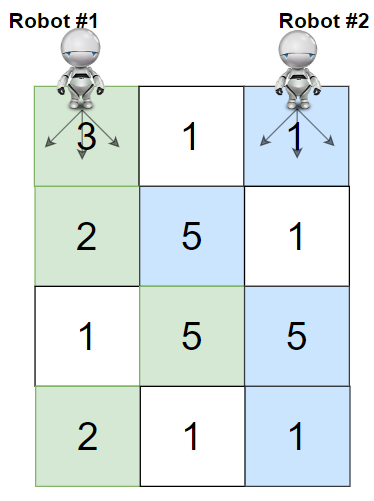
Input: grid = [[3,1,1],[2,5,1],[1,5,5],[2,1,1]]
Output: 24
Explanation: Path of robot #1 and #2 are described in color green and blue respectively.
Cherries taken by Robot #1, (3 + 2 + 5 + 2) = 12.
Cherries taken by Robot #2, (1 + 5 + 5 + 1) = 12.
Total of cherries: 12 + 12 = 24.
Example 2:
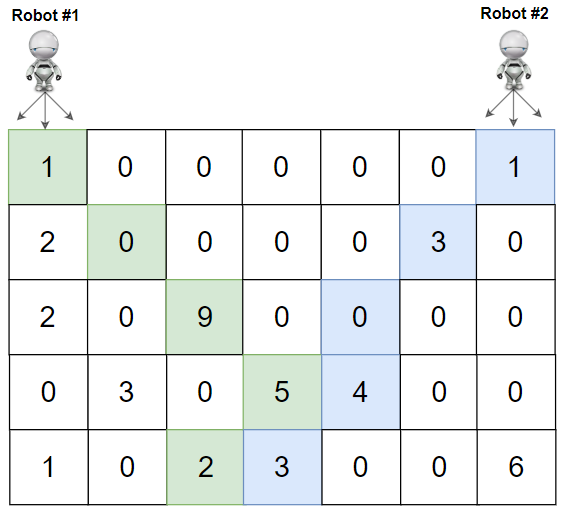
Input: grid = [[1,0,0,0,0,0,1],[2,0,0,0,0,3,0],[2,0,9,0,0,0,0],[0,3,0,5,4,0,0],[1,0,2,3,0,0,6]]
Output: 28
Explanation: Path of robot #1 and #2 are described in color green and blue respectively.
Cherries taken by Robot #1, (1 + 9 + 5 + 2) = 17.
Cherries taken by Robot #2, (1 + 3 + 4 + 3) = 11.
Total of cherries: 17 + 11 = 28.
Constraints:
rows == grid.lengthcols == grid[i].length2 <= rows, cols <= 700 <= grid[i][j] <= 100
Approaches
3 approaches with complexity analysis and trade-offs.
This approach directly translates the problem's state transitions into a recursive function. The state is defined by the current row and the column positions of the two robots. Since both robots move down one row at a time, they are always in the same row.
Algorithm
- Define a recursive function
solve(row, col1, col2)that returns the maximum cherries collected from the currentrowdownwards, with robots at(row, col1)and(row, col2). - Base Case: If
rowis the last row, return the cherries at the robots' positions. Ifcol1orcol2are out of bounds, return a very small number to signify an invalid path. - Recursive Step: For the current state
(row, col1, col2), calculate the cherries collected at this step. Then, explore all 9 possible next positions (col1 + d1,col2 + d2whered1, d2are in{-1, 0, 1}) in the next row by making recursive calls. - The result for the current state is the sum of current cherries and the maximum value returned from the 9 recursive calls.
- The initial call is
solve(0, 0, cols - 1).
Walkthrough
We define a recursive function, say solve(row, col1, col2), which calculates the maximum cherries that can be collected from the current row to the bottom, given robot 1 is at (row, col1) and robot 2 is at (row, col2). The function works as follows:
- Base Case: When the robots reach the last row (
row == rows - 1), they collect the cherries in their respective cells and the recursion stops. The value returned isgrid[row][col1] + grid[row][col2](or justgrid[row][col1]if they are in the same cell). - Recursive Step: For any other row, the function calculates the cherries collected at the current cells. Then, it explores all possible next moves for both robots. Robot 1 can move to
col1-1,col1, orcol1+1in the next row, and similarly for robot 2. This gives3 * 3 = 9possible combinations of next positions. The function recursively calls itself for each of these 9 combinations and takes the maximum result. This maximum is added to the cherries collected at the current row. - Boundary Checks: The function must handle cases where a robot moves outside the grid boundaries. Such paths are invalid and should return a value that ensures they are not chosen (e.g., a very small negative number).
- The initial call to the function is
solve(0, 0, cols - 1).
class Solution { public int cherryPickup(int[][] grid) { int rows = grid.length; int cols = grid[0].length; return solve(0, 0, cols - 1, grid); } private int solve(int row, int col1, int col2, int[][] grid) { int rows = grid.length; int cols = grid[0].length; // Boundary checks for columns if (col1 < 0 || col1 >= cols || col2 < 0 || col2 >= cols) { return Integer.MIN_VALUE; } // Cherries at the current step int cherries = grid[row][col1]; if (col1 != col2) { cherries += grid[row][col2]; } // Base case: last row if (row == rows - 1) { return cherries; } // Recursive step: explore all 9 possible next moves int maxFutureCherries = 0; for (int dc1 = -1; dc1 <= 1; dc1++) { for (int dc2 = -1; dc2 <= 1; dc2++) { maxFutureCherries = Math.max(maxFutureCherries, solve(row + 1, col1 + dc1, col2 + dc2, grid)); } } return cherries + maxFutureCherries; }}Complexity
Time
O(9^rows). At each row, the function branches into 9 recursive calls. The depth of the recursion is `rows`, leading to an exponential number of calls.
Space
O(rows) for the recursion call stack.
Trade-offs
Pros
Simple to understand and implement as it directly models the problem statement.
Cons
Extremely inefficient due to a massive number of redundant computations for the same subproblems.
Will result in a 'Time Limit Exceeded' error on any non-trivial input size.
Solutions
Solution
class Solution {public int cherryPickup(int[][] grid) { int m = grid.length, n = grid[0].length; int[][][] f = new int[m][n][n]; for (var g : f) { for (var h : g) { Arrays.fill(h, -1); } } f[0][0][n - 1] = grid[0][0] + grid[0][n - 1]; for (int i = 1; i < m; ++i) { for (int j1 = 0; j1 < n; ++j1) { for (int j2 = 0; j2 < n; ++j2) { int x = grid[i][j1] + (j1 == j2 ? 0 : grid[i][j2]); for (int y1 = j1 - 1; y1 <= j1 + 1; ++y1) { for (int y2 = j2 - 1; y2 <= j2 + 1; ++y2) { if (y1 >= 0 && y1 < n && y2 >= 0 && y2 < n && f[i - 1][y1][y2] != -1) { f[i][j1][j2] = Math.max(f[i][j1][j2], f[i - 1][y1][y2] + x); } } } } } } int ans = 0; for (int j1 = 0; j1 < n; ++j1) { for (int j2 = 0; j2 < n; ++j2) { ans = Math.max(ans, f[m - 1][j1][j2]); } } return ans; }}Video walkthrough
Newsletter
One sharp idea, every week
System design and interview prep — short enough to finish.
No spam. Unsubscribe anytime.
Practice
Same difficulty — related problems to reinforce the pattern.