
Dungeon Game
HardPrompt
The demons had captured the princess and imprisoned her in the bottom-right corner of a dungeon. The dungeon consists of m x n rooms laid out in a 2D grid. Our valiant knight was initially positioned in the top-left room and must fight his way through dungeon to rescue the princess.
The knight has an initial health point represented by a positive integer. If at any point his health point drops to 0 or below, he dies immediately.
Some of the rooms are guarded by demons (represented by negative integers), so the knight loses health upon entering these rooms; other rooms are either empty (represented as 0) or contain magic orbs that increase the knight's health (represented by positive integers).
To reach the princess as quickly as possible, the knight decides to move only rightward or downward in each step.
Return the knight's minimum initial health so that he can rescue the princess.
Note that any room can contain threats or power-ups, even the first room the knight enters and the bottom-right room where the princess is imprisoned.
Example 1:
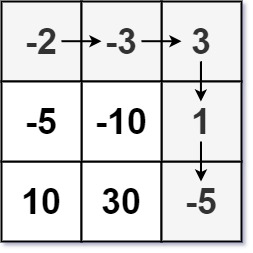
Input: dungeon = [[-2,-3,3],[-5,-10,1],[10,30,-5]]
Output: 7
Explanation: The initial health of the knight must be at least 7 if he follows the optimal path: RIGHT-> RIGHT -> DOWN -> DOWN.
Example 2:
Input: dungeon = [[0]]
Output: 1
Constraints:
m == dungeon.lengthn == dungeon[i].length1 <= m, n <= 200-1000 <= dungeon[i][j] <= 1000
Approaches
4 approaches with complexity analysis and trade-offs.
This approach uses simple recursion to explore all possible paths from the knight's starting position to the princess. The core idea is to work backward from the destination. We define a function that calculates the minimum health required at a cell (i, j) to guarantee survival until the end. This function recursively calls itself for the next possible cells (down and right) and chooses the path that requires less health.
Algorithm
- Define a recursive function
findMinHealth(row, col)that returns the minimum health needed upon entering cell(row, col). - Base Case: If the cell is the princess's room
(m-1, n-1), the healthhneeded must satisfyh + dungeon[m-1][n-1] >= 1. So, the required health ismax(1, 1 - dungeon[m-1][n-1]). - Boundary Conditions: If
roworcolgoes out of the grid, it's an invalid path. Return a very large value (e.g.,Integer.MAX_VALUE) to ensure this path is not chosen. - Recursive Step: For any other cell
(row, col), the knight can move down or right. The minimum health required for the rest of the journey is the minimum of the health needed for the path starting from(row+1, col)and the path from(row, col+1).minHealthForFuture = min(findMinHealth(row+1, col), findMinHealth(row, col+1))- The health
hat(row, col)must satisfyh + dungeon[row][col] >= minHealthForFuture. Therefore, the health needed ismax(1, minHealthForFuture - dungeon[row][col]).
- The initial call is
findMinHealth(0, 0).
Walkthrough
We define a recursive function, say findMinHealth(row, col), which calculates the minimum health required upon entering the cell (row, col) to be able to reach the princess. The function works as follows:
-
The base case is the princess's room at
(m-1, n-1). To survive this room, the knight's healthhmust satisfyh + dungeon[m-1][n-1] >= 1. Since health must always be at least 1, the minimum health required upon entering this cell ismax(1, 1 - dungeon[m-1][n-1]). -
For any other cell
(row, col), the knight can move down to(row+1, col)or right to(row, col+1). He will logically choose the path that requires a lower initial health. The minimum health needed for the subsequent journey ismin(findMinHealth(row+1, col), findMinHealth(row, col+1)). Let's call thisminHealthForFuture. -
The health
hupon entering(row, col)must be sufficient to survive the current room and the rest of the journey. This meansh + dungeon[row][col] >= minHealthForFuture. Thus, the health needed at(row, col)ismax(1, minHealthForFuture - dungeon[row][col]).
This recursive structure explores all possibilities, but since findMinHealth for the same cell is called multiple times through different paths, it leads to an exponential number of computations.
class Solution { public int calculateMinimumHP(int[][] dungeon) { // This will likely time out for larger inputs. return findMinHealth(dungeon, 0, 0); } private int findMinHealth(int[][] dungeon, int row, int col) { int m = dungeon.length; int n = dungeon[0].length; if (row >= m || col >= n) { return Integer.MAX_VALUE; } if (row == m - 1 && col == n - 1) { return Math.max(1, 1 - dungeon[row][col]); } int healthFromDown = findMinHealth(dungeon, row + 1, col); int healthFromRight = findMinHealth(dungeon, row, col + 1); int minHealthForFuture = Math.min(healthFromDown, healthFromRight); int neededHealth = minHealthForFuture - dungeon[row][col]; return Math.max(1, neededHealth); }}Complexity
Time
O(2^(m+n))
Space
O(m + n)
Trade-offs
Pros
Conceptually simple and a direct translation of the problem's recursive nature.
Cons
Extremely inefficient due to re-computation of the same subproblems.
Will result in a 'Time Limit Exceeded' error for all but the smallest of grids.
Solutions
Solution
public class Solution { public int CalculateMinimumHP ( int [][] dungeon ) { int m = dungeon . Length , n = dungeon [ 0 ]. Length ; int [][] dp = new int [ m + 1 ][]; for ( int i = 0 ; i < m + 1 ; ++ i ) { dp [ i ] = new int [ n + 1 ]; Array . Fill ( dp [ i ], 1 << 30 ); } dp [ m ][ n - 1 ] = dp [ m - 1 ][ n ] = 1 ; for ( int i = m - 1 ; i >= 0 ; -- i ) { for ( int j = n - 1 ; j >= 0 ; -- j ) { dp [ i ][ j ] = Math . Max ( 1 , Math . Min ( dp [ i + 1 ][ j ], dp [ i ][ j + 1 ]) - dungeon [ i ][ j ]); } } return dp [ 0 ][ 0 ]; } }Video walkthrough
Newsletter
One sharp idea, every week
System design and interview prep — short enough to finish.
No spam. Unsubscribe anytime.
Practice
Same difficulty — related problems to reinforce the pattern.