
Fill a Special Grid
MedPrompt
You are given a non-negative integer n representing a 2n x 2n grid. You must fill the grid with integers from 0 to 22n - 1 to make it special. A grid is special if it satisfies all the following conditions:
- All numbers in the top-right quadrant are smaller than those in the bottom-right quadrant.
- All numbers in the bottom-right quadrant are smaller than those in the bottom-left quadrant.
- All numbers in the bottom-left quadrant are smaller than those in the top-left quadrant.
- Each of its quadrants is also a special grid.
Return the special 2n x 2n grid.
Note: Any 1x1 grid is special.
Example 1:
Input: n = 0
Output: [[0]]
Explanation:
The only number that can be placed is 0, and there is only one possible position in the grid.
Example 2:
Input: n = 1
Output: [[3,0],[2,1]]
Explanation:
The numbers in each quadrant are:
- Top-right: 0
- Bottom-right: 1
- Bottom-left: 2
- Top-left: 3
Since 0 < 1 < 2 < 3, this satisfies the given constraints.
Example 3:
Input: n = 2
Output: [[15,12,3,0],[14,13,2,1],[11,8,7,4],[10,9,6,5]]
Explanation:
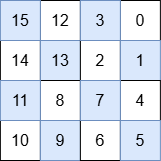
The numbers in each quadrant are:
- Top-right: 3, 0, 2, 1
- Bottom-right: 7, 4, 6, 5
- Bottom-left: 11, 8, 10, 9
- Top-left: 15, 12, 14, 13
max(3, 0, 2, 1) < min(7, 4, 6, 5)max(7, 4, 6, 5) < min(11, 8, 10, 9)max(11, 8, 10, 9) < min(15, 12, 14, 13)
This satisfies the first three requirements. Additionally, each quadrant is also a special grid. Thus, this is a special grid.
Constraints:
0 <= n <= 10
Approaches
2 approaches with complexity analysis and trade-offs.
This approach calculates the value for each cell (r, c) of the grid independently. The core idea is that the value at any cell is determined by which quadrant it falls into at each level of recursion, from the largest 2^n x 2^n grid down to a 1x1 grid. This can be mapped to the binary representations of the row r and column c indices.
Algorithm
- Calculate the grid dimension
dim = 2^n. - Create an empty
dim x diminteger gridresult. - Loop for
rfrom0todim - 1. - Loop for
cfrom0todim - 1. - For each cell
(r, c), calculate its value using a helper function based on bit manipulation:- Initialize
cellValue = 0andpowerOf4 = 1. - Loop for
ifrom0ton - 1. - Extract the
i-th bit ofr(r_i) andc(c_i). - Determine the quadrant multiplier
Qbased on the pair(r_i, c_i):(0, 1)(Top-Right) ->Q=0(1, 1)(Bottom-Right) ->Q=1(1, 0)(Bottom-Left) ->Q=2(0, 0)(Top-Left) ->Q=3
- Add
Q * powerOf4tocellValue. - Update
powerOf4by multiplying it by 4.
- Initialize
- Assign the calculated
cellValuetoresult[r][c]. - Return
result.
Walkthrough
The value at grid[r][c] can be expressed as a sum: value = Σ (Q_i * 4^i) for i from 0 to n-1.
Q_i is a "quadrant multiplier" determined by the i-th bits of r and c, let's say r_i and c_i. The pair (r_i, c_i) corresponds to a quadrant at the i-th level of subdivision. The multipliers are derived from the problem's ordering constraint (TR < BR < BL < TL):
(0, 1)(Top-Right): Multiplier0(1, 1)(Bottom-Right): Multiplier1(1, 0)(Bottom-Left): Multiplier2(0, 0)(Top-Left): Multiplier3
The algorithm iterates through each cell (r, c) of the 2^n x 2^n grid. For each cell, it iterates from i = 0 to n-1, extracts the i-th bits of r and c, determines the multiplier Q_i, and adds Q_i * 4^i to the total value for that cell.
class Solution { public int[][] fillSpecialGrid(int n) { int dim = 1 << n; // 2^n int[][] grid = new int[dim][dim]; for (int r = 0; r < dim; r++) { for (int c = 0; c < dim; c++) { int value = 0; long powerOf4 = 1; for (int i = 0; i < n; i++) { int r_bit = (r >> i) & 1; int c_bit = (c >> i) & 1; int multiplier; if (r_bit == 0 && c_bit == 0) { // Top-Left in sub-grid multiplier = 3; } else if (r_bit == 0 && c_bit == 1) { // Top-Right multiplier = 0; } else if (r_bit == 1 && c_bit == 0) { // Bottom-Left multiplier = 2; } else { // Bottom-Right multiplier = 1; } value += multiplier * powerOf4; powerOf4 *= 4; } grid[r][c] = value; } } return grid; }}Complexity
Time
O(n * 4^n) - We iterate through `4^n` cells, and for each cell, we perform a loop of `n` iterations to calculate its value.
Space
O(4^n) - We need to store the final `2^n x 2^n` grid. The space used by variables within the loops is negligible.
Trade-offs
Pros
Each cell's value is computed independently, which could be parallelized.
Avoids recursion and the potential for stack overflow (though not an issue with the given constraints).
Cons
Less efficient than the recursive construction approach due to the extra factor of
nin the time complexity.It re-calculates information for each cell instead of building upon previous results.
Video walkthrough
Newsletter
One sharp idea, every week
System design and interview prep — short enough to finish.
No spam. Unsubscribe anytime.
Practice
Same difficulty — related problems to reinforce the pattern.