
Find Elements in a Contaminated Binary Tree
MedPrompt
Given a binary tree with the following rules:
root.val == 0- For any
treeNode:- If
treeNode.valhas a valuexandtreeNode.left != null, thentreeNode.left.val == 2 * x + 1 - If
treeNode.valhas a valuexandtreeNode.right != null, thentreeNode.right.val == 2 * x + 2
- If
Now the binary tree is contaminated, which means all treeNode.val have been changed to -1.
Implement the FindElements class:
FindElements(TreeNode* root)Initializes the object with a contaminated binary tree and recovers it.bool find(int target)Returnstrueif thetargetvalue exists in the recovered binary tree.
Example 1:
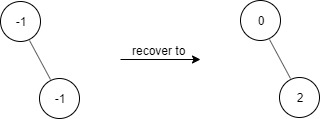
Input
["FindElements","find","find"]
[[[-1,null,-1]],[1],[2]]
Output
[null,false,true]
Explanation
FindElements findElements = new FindElements([-1,null,-1]);
findElements.find(1); // return False
findElements.find(2); // return True
Example 2:
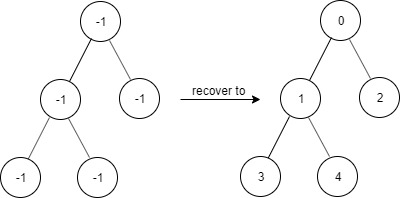
Input
["FindElements","find","find","find"]
[[[-1,-1,-1,-1,-1]],[1],[3],[5]]
Output
[null,true,true,false]
Explanation
FindElements findElements = new FindElements([-1,-1,-1,-1,-1]);
findElements.find(1); // return True
findElements.find(3); // return True
findElements.find(5); // return False
Example 3:
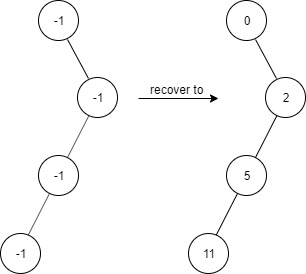
Input
["FindElements","find","find","find","find"]
[[[-1,null,-1,-1,null,-1]],[2],[3],[4],[5]]
Output
[null,true,false,false,true]
Explanation
FindElements findElements = new FindElements([-1,null,-1,-1,null,-1]);
findElements.find(2); // return True
findElements.find(3); // return False
findElements.find(4); // return False
findElements.find(5); // return True
Constraints:
TreeNode.val == -1- The height of the binary tree is less than or equal to
20 - The total number of nodes is between
[1, 104] - Total calls of
find()is between[1, 104] 0 <= target <= 106
Approaches
3 approaches with complexity analysis and trade-offs.
This approach avoids any pre-computation in the constructor. For each call to find(target), it traverses the tree from the root, calculating the "recovered" value for each node on the fly. It checks if any of these calculated values match the target.
Algorithm
- In the
FindElementsconstructor, simply store a reference to the root of the contaminated tree. - The
find(target)method initiates a traversal (like Depth-First Search) starting from the root. - A recursive helper function, say
dfs(node, currentValue, target), is used for the traversal. - The initial call is
dfs(root, 0, target). - Inside the
dfsfunction:- If the current
nodeisnull, or ifcurrentValueis greater thantarget, returnfalseas the target cannot be found in this subtree. - If
currentValueequalstarget, returntrue. - Recursively call
dfsfor the left child with value2 * currentValue + 1and the right child with value2 * currentValue + 2. - Return
trueif either of the recursive calls finds the target.
- If the current
Walkthrough
The FindElements constructor simply stores a reference to the root of the contaminated tree. The find(target) method initiates a traversal (like Depth-First Search or Breadth-First Search) starting from the root. The root's recovered value is 0. For any node with a recovered value x, its left child's value is 2*x + 1 and its right child's value is 2*x + 2. During the traversal, we keep track of the current node's correct value. If this value matches the target, we return true. If the entire tree is traversed without finding the target, we return false. This is essentially performing a new search on the conceptual recovered tree for every find call.
class FindElements { private TreeNode root; public FindElements(TreeNode root) { this.root = root; } public boolean find(int target) { return dfs(root, 0, target); } private boolean dfs(TreeNode node, int currentValue, int target) { if (node == null || currentValue > target) { return false; } if (currentValue == target) { return true; } return dfs(node.left, 2 * currentValue + 1, target) || dfs(node.right, 2 * currentValue + 2, target); }}Complexity
Time
Constructor: `O(1)`. `find(target)`: `O(N)`, where N is the number of nodes in the tree. In the worst case, we have to visit every node to find (or not find) the target.
Space
`O(H)`, where H is the height of the tree. This space is used by the recursion stack. In the worst case of a skewed tree, this can be `O(N)`.
Trade-offs
Pros
Simple to understand and implement.
No upfront cost in the constructor (
O(1)time).Minimal memory usage (
O(H)for recursion stack).
Cons
The
findoperation is very slow with a time complexity ofO(N), where N is the number of nodes.For problems with a large number of
findcalls, this approach is highly likely to exceed the time limit.
This approach leverages the mathematical relationship between a node's value and its parent's value. Instead of searching the tree for the target, we start from the target value and mathematically compute the path back to the root (value 0). Then, we verify if this computed path actually exists in the physical tree structure.
Algorithm
- In the constructor, just save the
rootnode. - In the
find(target)method:- Handle edge cases: if
target < 0, returnfalse. Iftarget == 0, returntrue. - Reconstruct the path from the
targetup to the root (value 0). Start withcurrent = target. - In a loop, while
current > 0, determine ifcurrentis a left or right child and add the direction to a list. Then updatecurrentto its parent's value:parent = (current - 1) / 2. - After the path is built, traverse the actual tree from the
rootfollowing the path directions in reverse order. - If at any point the traversal leads to a
nullnode, the path is invalid. Returnfalse. - If the traversal completes successfully, the node exists. Return
true.
- Handle edge cases: if
Walkthrough
The key insight is that for any node with value v > 0, its parent's value is (v - 1) / 2 (using integer division). The constructor only needs to store the root of the tree. The find(target) method first reconstructs the path from the target to the root by repeatedly calculating the parent. For a value c, it's a left child if odd and a right child if even. After building the path, we traverse the actual tree from the root, following these directions. If we ever encounter a null node, the path doesn't exist. If we successfully complete the traversal, the node exists.
class FindElements { private TreeNode root; public FindElements(TreeNode root) { this.root = root; } public boolean find(int target) { if (target < 0) { return false; } TreeNode node = this.root; int current = target; // We can check the path while reconstructing it to save space // We need to find the path from root to target, so we first find the path from target to root // and then traverse it backwards. A simpler way is to use binary representation of (target+1) // The path from root to a node with value `x` is encoded in the binary representation of `x+1`. // For example, for target=4, 4+1=5, binary is 101. Ignore the leading 1. Path is R, L. // 0 -> right -> 2 -> left -> 5. No, this is not correct. Let's stick to path reconstruction. java.util.Deque<Integer> path = new java.util.ArrayDeque<>(); while (current > 0) { path.push(current); current = (current - 1) / 2; } while (!path.isEmpty()) { if (node == null) return false; int val = path.pop(); if (val % 2 == 1) { // Left child node = node.left; } else { // Right child node = node.right; } } return node != null; }}Complexity
Time
Constructor: `O(1)`. `find(target)`: `O(H)` or `O(log target)`. The path reconstruction and the tree traversal both take a number of steps proportional to the depth of the target node, which is bounded by the tree height `H`.
Space
`O(H)` or `O(log target)`, where H is the tree height. This space is used to store the reconstructed path from the target to the root.
Trade-offs
Pros
Very fast
findoperation withO(H)complexity.Instantaneous constructor (
O(1)).Excellent space efficiency, using only
O(H)extra space.
Cons
The logic is more complex to implement compared to other approaches.
Each
findcall requiresO(H)time, which is slower than theO(1)of the pre-computation approach.
This approach prioritizes the speed of the find operation by doing all the work upfront in the constructor. It recovers the entire tree, calculates the correct value for every node, and stores all these values in a HashSet for near-instantaneous lookups.
Algorithm
- Initialize a
HashSet<Integer>as a member variable to store recovered values. - In the
FindElementsconstructor, traverse the entire tree using a recursive helper function, e.g.,recover(node, val). - The initial call is
recover(root, 0). - The
recoverfunction:- Base case: If
nodeisnull, return. - Add the current
valto theHashSet. - Recursively call
recover(node.left, 2 * val + 1). - Recursively call
recover(node.right, 2 * val + 2).
- Base case: If
- In the
find(target)method, simply check if thetargetis present in theHashSetusingcontains()and return the result.
Walkthrough
In the FindElements constructor, we traverse the entire contaminated tree, for example, using a recursive Depth-First Search (DFS). We maintain a HashSet to store the recovered values. The traversal starts at the root, which is assigned the value 0. This value is added to the set. For any node with a calculated value x, we recursively visit its left child with the value 2*x + 1 and its right child with the value 2*x + 2. The calculated values for these children are also added to the set. After the constructor finishes, the HashSet contains all the valid node values in the recovered tree. The find(target) method then becomes a simple and extremely fast operation: it just checks if the target exists in the HashSet.
import java.util.HashSet;import java.util.Set; class FindElements { private Set<Integer> values = new HashSet<>(); public FindElements(TreeNode root) { recover(root, 0); } private void recover(TreeNode node, int val) { if (node == null) { return; } values.add(val); recover(node.left, 2 * val + 1); recover(node.right, 2 * val + 2); } public boolean find(int target) { return values.contains(target); }}Complexity
Time
Constructor: `O(N)`, where N is the number of nodes. We must visit every node once. `find(target)`: `O(1)` on average, as `HashSet.contains` is a constant-time operation.
Space
`O(N)`, where N is the number of nodes. This space is required to store all the recovered node values in the `HashSet`.
Trade-offs
Pros
Extremely fast
findoperation,O(1)on average.Ideal for scenarios with a large number of
findqueries.The implementation logic is relatively straightforward.
Cons
The constructor has a time complexity of
O(N), which involves a full tree traversal and can be slow for very large trees.Requires
O(N)extra space to store all the node values, which might be a concern for memory-constrained environments.
Solutions
Solution
/** * Definition for a binary tree node. * public class TreeNode { * int val; * TreeNode left; * TreeNode right; * TreeNode() {} * TreeNode(int val) { this.val = val; } * TreeNode(int val, TreeNode left, TreeNode right) { * this.val = val; * this.left = left; * this.right = right; * } * } */ class FindElements { private Set < Integer > vis = new HashSet <>(); public FindElements ( TreeNode root ) { root . val = 0 ; dfs ( root ); } private void dfs ( TreeNode root ) { vis . add ( root . val ); if ( root . left != null ) { root . left . val = root . val * 2 + 1 ; dfs ( root . left ); } if ( root . right != null ) { root . right . val = root . val * 2 + 2 ; dfs ( root . right ); } } public boolean find ( int target ) { return vis . contains ( target ); } } /** * Your FindElements object will be instantiated and called as such: * FindElements obj = new FindElements(root); * boolean param_1 = obj.find(target); *//** * Definition for a binary tree node. * function TreeNode(val, left, right) { * this.val = (val===undefined ? 0 : val) * this.left = (left===undefined ? null : left) * this.right = (right===undefined ? null : right) * } */ const s = Symbol.for(" s ");/** * @param {TreeNode} root */ var FindElements = function (root) { root.val = 0; this[s] = new Set(); const dfs = (node, x = 0) => { if (!node) return; this[s].add(x); dfs(node.left, x * 2 + 1); dfs(node.right, x * 2 + 2); }; dfs(root);};/** * @param {number} target * @return {boolean} */ FindElements.prototype.find = function (target) { return this[s].has(target); }; /** * Your FindElements object will be instantiated and called as such: * var obj = new FindElements(root) * var param_1 = obj.find(target) *//** * Definition for a binary tree node. * struct TreeNode { * int val; * TreeNode *left; * TreeNode *right; * TreeNode() : val(0), left(nullptr), right(nullptr) {} * TreeNode(int x) : val(x), left(nullptr), right(nullptr) {} * TreeNode(int x, TreeNode *left, TreeNode *right) : val(x), left(left), right(right) {} * }; */ class FindElements { public: FindElements ( TreeNode * root ) { root -> val = 0 ; function < void ( TreeNode * ) > dfs = [ & ]( TreeNode * root ) { vis . insert ( root -> val ); if ( root -> left ) { root -> left -> val = root -> val * 2 + 1 ; dfs ( root -> left ); } if ( root -> right ) { root -> right -> val = root -> val * 2 + 2 ; dfs ( root -> right ); } }; dfs ( root ); } bool find ( int target ) { return vis . count ( target ); } private: unordered_set < int > vis ; }; /** * Your FindElements object will be instantiated and called as such: * FindElements* obj = new FindElements(root); * bool param_1 = obj->find(target); */# Definition for a binary tree node. # class TreeNode: # def __init__(self, val=0, left=None, right=None): # self.val = val # self.left = left # self.right = right class FindElements : def __init__ ( self , root : Optional [ TreeNode ]): def dfs ( root ): self . vis . add ( root . val ) if root . left : root . left . val = root . val * 2 + 1 dfs ( root . left ) if root . right : root . right . val = root . val * 2 + 2 dfs ( root . right ) root . val = 0 self . vis = set () dfs ( root ) def find ( self , target : int ) -> bool : return target in self . vis # Your FindElements object will be instantiated and called as such: # obj = FindElements(root) # param_1 = obj.find(target)Video walkthrough
Newsletter
One sharp idea, every week
System design and interview prep — short enough to finish.
No spam. Unsubscribe anytime.
Practice
Same difficulty — related problems to reinforce the pattern.