
Maximal Rectangle
HardPrompt
Given a rows x cols binary matrix filled with 0's and 1's, find the largest rectangle containing only 1's and return its area.
Example 1:
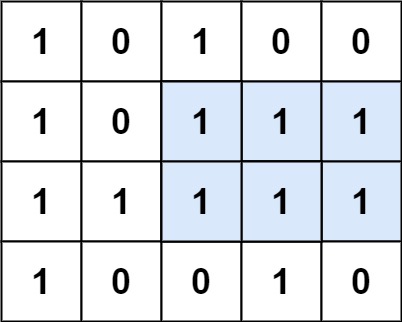
Input: matrix = [["1","0","1","0","0"],["1","0","1","1","1"],["1","1","1","1","1"],["1","0","0","1","0"]]
Output: 6
Explanation: The maximal rectangle is shown in the above picture.
Example 2:
Input: matrix = [["0"]]
Output: 0
Example 3:
Input: matrix = [["1"]]
Output: 1
Constraints:
rows == matrix.lengthcols == matrix[i].length1 <= row, cols <= 200matrix[i][j]is'0'or'1'.
Approaches
2 approaches with complexity analysis and trade-offs.
This approach iterates through each cell (i, j) and considers it as the top-left corner of a potential maximal rectangle. For each such corner, it expands downwards row by row, calculating the maximum possible rectangle area. To optimize the width calculation, it precomputes the number of consecutive '1's to the right for every cell.
Algorithm
- Initialize
maxAreato 0. - If the matrix is empty, return 0.
- Get the number of rows and columns.
- Create a 2D integer array
widthof the same dimensions as the input matrix. - Precompute the
widtharray. For each rowi, iterate from right to left (fromj = cols - 1to 0):- If
matrix[i][j]is '1', setwidth[i][j]to1 + width[i][j+1]. Ifjis the last column, it's just 1. - If
matrix[i][j]is '0', setwidth[i][j]to 0.
- If
- Iterate through each cell
(i, j)of the matrix, considering it as a potential top-left corner of a rectangle. - For each
(i, j):- Initialize
minWidthto a very large value. - Iterate downwards from the current row
k = ito the last row.- Update
minWidthto be the minimum of its current value andwidth[k][j]. ThisminWidthrepresents the width of the rectangle that spans from rowitokstarting at columnj. - If
minWidthbecomes 0, it means the rectangle is broken, so we can break the inner loop. - Calculate the height of the current rectangle as
k - i + 1. - Calculate the area as
minWidth * height. - Update
maxAreawith the maximum area found so far.
- Update
- Initialize
- Return
maxArea.
Walkthrough
A brute-force solution would be to check every possible rectangle, which is highly inefficient. We can improve this by fixing the top-left corner and the height of the rectangle and then finding the maximum possible width.
This approach pre-calculates, for each cell (i, j), the number of consecutive '1's to its right, including itself. Let's call this width[i][j]. This precomputation step takes O(rows * cols) time.
After precomputation, the main algorithm iterates through every cell (i, j) as a potential top-left corner. For each (i, j), it iterates downwards to every possible bottom row k. For a rectangle defined by top-left (i, j) and bottom row k, the height is k - i + 1. The width is limited by the narrowest stretch of '1's starting from column j in any row from i to k. This is equivalent to min(width[i][j], width[i+1][j], ..., width[k][j]). We calculate this area and update our global maximum.
class Solution { public int maximalRectangle(char[][] matrix) { if (matrix == null || matrix.length == 0 || matrix[0].length == 0) { return 0; } int rows = matrix.length; int cols = matrix[0].length; int[][] width = new int[rows][cols]; // Precompute width of consecutive '1's to the right for (int i = 0; i < rows; i++) { for (int j = cols - 1; j >= 0; j--) { if (matrix[i][j] == '1') { width[i][j] = (j == cols - 1) ? 1 : width[i][j + 1] + 1; } else { width[i][j] = 0; } } } int maxArea = 0; // Iterate through each cell as a potential top-left corner for (int i = 0; i < rows; i++) { for (int j = 0; j < cols; j++) { int minWidth = Integer.MAX_VALUE; // Expand downwards for (int k = i; k < rows; k++) { // The width of the rectangle is limited by the narrowest row minWidth = Math.min(minWidth, width[k][j]); if (minWidth == 0) break; // No more rectangle possible int height = k - i + 1; maxArea = Math.max(maxArea, minWidth * height); } } } return maxArea; }}Complexity
Time
O(rows^2 * cols)
Space
O(rows * cols)
Trade-offs
Pros
More intuitive and easier to come up with than the most optimal solution.
It's a significant improvement over a naive O(rows^3 * cols^3) brute-force approach.
Cons
The time complexity of O(rows^2 * cols) can be too slow for large matrices.
It uses extra space proportional to the size of the matrix, which can be significant.
Solutions
Solution
using System ; using System.Collections.Generic ; using System.Linq ; public class Solution { private int MaximalRectangleHistagram ( int [] height ) { var stack = new Stack < int >(); var result = 0 ; var i = 0 ; while ( i < height . Length || stack . Any ()) { if (! stack . Any () || ( i < height . Length && height [ stack . Peek ()] < height [ i ])) { stack . Push ( i ); ++ i ; } else { var previousIndex = stack . Pop (); var area = height [ previousIndex ] * ( stack . Any () ? ( i - stack . Peek () - 1 ) : i ); result = Math . Max ( result , area ); } } return result ; } public int MaximalRectangle ( char [][] matrix ) { var lenI = matrix . Length ; var lenJ = lenI == 0 ? 0 : matrix [ 0 ]. Length ; var height = new int [ lenJ ]; var result = 0 ; for ( var i = 0 ; i < lenI ; ++ i ) { for ( var j = 0 ; j < lenJ ; ++ j ) { if ( matrix [ i ][ j ] == '1' ) { ++ height [ j ]; } else { height [ j ] = 0 ; } } result = Math . Max ( result , MaximalRectangleHistagram ( height )); } return result ; } }Video walkthrough
Newsletter
One sharp idea, every week
System design and interview prep — short enough to finish.
No spam. Unsubscribe anytime.
Practice
Same difficulty — related problems to reinforce the pattern.