
Partition List
MedPrompt
Given the head of a linked list and a value x, partition it such that all nodes less than x come before nodes greater than or equal to x.
You should preserve the original relative order of the nodes in each of the two partitions.
Example 1:
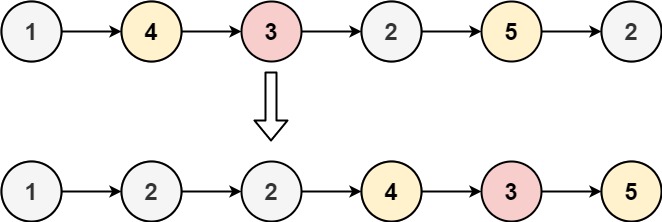
Input: head = [1,4,3,2,5,2], x = 3
Output: [1,2,2,4,3,5]
Example 2:
Input: head = [2,1], x = 2
Output: [1,2]
Constraints:
- The number of nodes in the list is in the range
[0, 200]. -100 <= Node.val <= 100-200 <= x <= 200
Approaches
2 approaches with complexity analysis and trade-offs.
This approach involves converting the linked list into a more flexible data structure, like an array or list, to make partitioning easier. We iterate through the original list, segregating nodes into two separate lists based on the pivot value x. One list holds nodes with values less than x, and the other holds nodes with values greater than or equal to x. After populating these lists, we link them together to form the final partitioned linked list.
Algorithm
-
- Create two auxiliary
ArrayLists: one to store nodes with values less thanx(lesserNodes) and another for nodes with values greater than or equal tox(greaterOrEqualNodes).
- Create two auxiliary
-
- Traverse the input linked list from the
head.
- Traverse the input linked list from the
-
- For each node encountered, check its value. If
node.val < x, add the node tolesserNodes. Otherwise, add it togreaterOrEqualNodes.
- For each node encountered, check its value. If
-
- After the entire list has been traversed, the two
ArrayListswill contain all the nodes, partitioned and with their relative order preserved within each partition.
- After the entire list has been traversed, the two
-
- Create a new dummy
ListNodeto serve as the starting point for the result list.
- Create a new dummy
-
- Iterate through
lesserNodesand append each node to the new list.
- Iterate through
-
- Then, iterate through
greaterOrEqualNodesand append each node to the end of the new list.
- Then, iterate through
-
- Finally, set the
nextpointer of the last node in the newly formed list tonullto prevent cycles.
- Finally, set the
-
- Return the
nextof the dummy node, which is the head of the final partitioned list.
- Return the
Walkthrough
The core idea is to offload the linked list nodes into two separate lists. This simplifies the partitioning logic as we don't have to manage next pointers during the segregation phase.
First, we iterate through the linked list once. During this traversal, we check each node's value against x. If the value is smaller, we add the node to a lesserNodes list. If it's greater or equal, we add it to a greaterOrEqualNodes list. Because we add nodes to the end of these lists in the order we encounter them, the original relative ordering within each partition is naturally preserved.
Once the segregation is complete, we construct the new linked list. We create a dummy head to simplify the building process. We first link all nodes from the lesserNodes list, and then we link all nodes from the greaterOrEqualNodes list. It's crucial to set the next pointer of the very last node to null to correctly terminate the list.
/** * Definition for singly-linked list. * public class ListNode { * int val; * ListNode next; * ListNode() {} * ListNode(int val) { this.val = val; } * ListNode(int val, ListNode next) { this.val = val; this.next = next; } * } */class Solution { public ListNode partition(ListNode head, int x) { // Store nodes in two separate lists java.util.List<ListNode> lesserNodes = new java.util.ArrayList<>(); java.util.List<ListNode> greaterOrEqualNodes = new java.util.ArrayList<>(); ListNode current = head; while (current != null) { if (current.val < x) { lesserNodes.add(current); } else { greaterOrEqualNodes.add(current); } current = current.next; } // Reconstruct the linked list ListNode dummy = new ListNode(0); ListNode newTail = dummy; for (ListNode node : lesserNodes) { newTail.next = node; newTail = newTail.next; } for (ListNode node : greaterOrEqualNodes) { newTail.next = node; newTail = newTail.next; } // Terminate the list newTail.next = null; return dummy.next; }}Complexity
Time
O(N)
Space
O(N)
Trade-offs
Pros
Conceptually straightforward and easy to implement.
Separates the concern of partitioning from the complexities of linked list pointer manipulation.
Cons
Requires O(N) extra space for the auxiliary lists, which is inefficient for large inputs.
This approach is not in-place; it reconstructs the list structure rather than just rearranging pointers.
Solutions
Solution
/** * Definition for singly-linked list. * public class ListNode { * public int val; * public ListNode next; * public ListNode(int val=0, ListNode next=null) { * this.val = val; * this.next = next; * } * } */ public class Solution { public ListNode Partition ( ListNode head , int x ) { ListNode l = new ListNode (); ListNode r = new ListNode (); ListNode tl = l , tr = r ; for (; head != null ; head = head . next ) { if ( head . val < x ) { tl . next = head ; tl = tl . next ; } else { tr . next = head ; tr = tr . next ; } } tr . next = null ; tl . next = r . next ; return l . next ; } }Video walkthrough
Newsletter
One sharp idea, every week
System design and interview prep — short enough to finish.
No spam. Unsubscribe anytime.
Practice
Same difficulty — related problems to reinforce the pattern.