
Maximum Star Sum of a Graph
MedPrompt
There is an undirected graph consisting of n nodes numbered from 0 to n - 1. You are given a 0-indexed integer array vals of length n where vals[i] denotes the value of the ith node.
You are also given a 2D integer array edges where edges[i] = [ai, bi] denotes that there exists an undirected edge connecting nodes ai and bi.
A star graph is a subgraph of the given graph having a center node containing 0 or more neighbors. In other words, it is a subset of edges of the given graph such that there exists a common node for all edges.
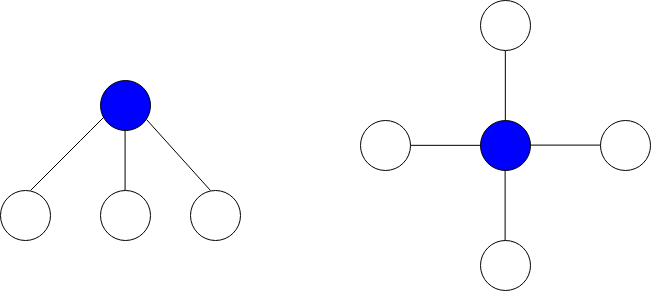
The image below shows star graphs with 3 and 4 neighbors respectively, centered at the blue node.
The star sum is the sum of the values of all the nodes present in the star graph.
Given an integer k, return the maximum star sum of a star graph containing at most k edges.
Example 1:
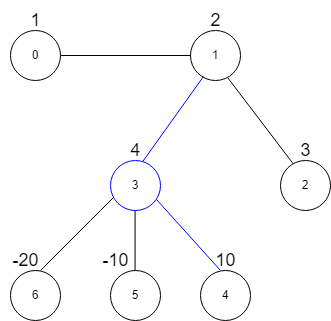
Input: vals = [1,2,3,4,10,-10,-20], edges = [[0,1],[1,2],[1,3],[3,4],[3,5],[3,6]], k = 2
Output: 16
Explanation: The above diagram represents the input graph.
The star graph with the maximum star sum is denoted by blue. It is centered at 3 and includes its neighbors 1 and 4.
It can be shown it is not possible to get a star graph with a sum greater than 16.
Example 2:
Input: vals = [-5], edges = [], k = 0
Output: -5
Explanation: There is only one possible star graph, which is node 0 itself.
Hence, we return -5.
Constraints:
n == vals.length1 <= n <= 105-104 <= vals[i] <= 1040 <= edges.length <= min(n * (n - 1) / 2, 105)edges[i].length == 20 <= ai, bi <= n - 1ai != bi0 <= k <= n - 1
Approaches
2 approaches with complexity analysis and trade-offs.
This approach iterates through each node, considering it as a potential center of a star graph. For each potential center, it calculates the maximum possible star sum by adding the values of its k most valuable neighbors. To find these neighbors, it collects the values of all neighbors, filters for positive ones, sorts them in descending order, and picks the top k. The overall maximum sum found across all possible centers is the answer.
Algorithm
- Create an adjacency list to represent the graph from the
edgesarray. - Initialize a variable
maxSumtoInteger.MIN_VALUE. - Iterate through each node
ifrom0ton-1, treating it as the center of a star graph. - For each center
i, initializecurrentSum = vals[i]. - Create a list to store the values of its neighbors.
- Iterate through the neighbors of
iusing the adjacency list. If a neighbor's value is positive, add it to the list. - Sort the list of positive neighbor values in descending order.
- Add the top
kvalues (or fewer if the list is smaller thank) from the sorted list tocurrentSum. - Update
maxSumwith the maximum ofmaxSumandcurrentSum. - After iterating through all nodes, return
maxSum.
Walkthrough
The core idea is to check every node as a potential center for the star graph.
First, we need an efficient way to access the neighbors of any given node. An adjacency list is a suitable data structure for this, which can be built by iterating through the edges array once.
We initialize a variable maxSum to the smallest possible integer value to keep track of the maximum star sum found so far.
Then, we loop through each node i from 0 to n-1.
- For each node
i, we calculate the potential star sum withias the center. The sum starts withvals[i]. - We gather the values of all neighbors of
i. We are only interested in neighbors that increase the total sum, so we only consider neighbors with positive values. - We store these positive neighbor values in a list.
- To pick the best
kneighbors, we sort this list of positive values in descending order. - We then iterate up to
ktimes (or until we run out of positive neighbors) and add the values from the sorted list to our current sum. - After calculating the maximum possible sum for the center
i, we updatemaxSum = max(maxSum, currentSum).
After checking all nodes as potential centers, maxSum will hold the final answer.
import java.util.*; class Solution { public int maxStarSum(int[] vals, int[][] edges, int k) { int n = vals.length; List<List<Integer>> adj = new ArrayList<>(); for (int i = 0; i < n; i++) { adj.add(new ArrayList<>()); } for (int[] edge : edges) { adj.get(edge[0]).add(edge[1]); adj.get(edge[1]).add(edge[0]); } int maxSum = Integer.MIN_VALUE; for (int i = 0; i < n; i++) { int currentSum = vals[i]; List<Integer> neighborValues = new ArrayList<>(); for (int neighbor : adj.get(i)) { if (vals[neighbor] > 0) { neighborValues.add(vals[neighbor]); } } Collections.sort(neighborValues, Collections.reverseOrder()); for (int j = 0; j < Math.min(k, neighborValues.size()); j++) { currentSum += neighborValues.get(j); } maxSum = Math.max(maxSum, currentSum); } return maxSum; }}Complexity
Time
O(E + Σ(deg(i) * log(deg(i)))) over all nodes `i`. A simpler upper bound is `O(E * log N)`, where `E` is the number of edges and `N` is the number of nodes. Building the adjacency list takes `O(E)`. For each node `i`, we sort its neighbors, taking `O(deg(i) * log(deg(i)))`. The sum of degrees `Σdeg(i)` is `2*E`.
Space
O(E + N), where `E` is the number of edges and `N` is the number of nodes. This is for the adjacency list and the temporary list for sorting neighbor values (which can be up to size `N-1` in the worst case).
Trade-offs
Pros
Relatively straightforward to understand and implement.
Correctly solves the problem.
Cons
Sorting all positive neighbors for each node can be inefficient, especially if
kis small compared to the node's degree. We only need the topkelements, not a fully sorted list.
This approach improves upon the sorting method. Instead of sorting all positive neighbor values for each center node, it uses a min-heap (Priority Queue) of size k to efficiently find the k largest positive neighbor values. This avoids the cost of a full sort, making it more efficient, especially when a node has many neighbors but k is small.
Algorithm
- Create an adjacency list to represent the graph.
- Initialize
maxSumtoInteger.MIN_VALUE. - Iterate through each node
ifrom0ton-1as a potential center. - For each center
i, initializecurrentSum = vals[i]. - Create a min-heap (PriorityQueue) to keep track of the largest neighbor values.
- Iterate through the neighbors of
i. For each neighborjwithvals[j] > 0:- Add
vals[j]to the heap. - If the heap's size is greater than
k, remove the smallest element from the heap (poll()).
- Add
- After iterating through all neighbors, sum the elements remaining in the heap and add them to
currentSum. - Update
maxSum = max(maxSum, currentSum). - After checking all nodes, return
maxSum.
Walkthrough
Similar to the first approach, we iterate through each node i as a potential center. The graph representation is also an adjacency list.
The key difference lies in how we select the top k neighbors. Instead of collecting all positive neighbor values and sorting them, we use a min-heap of a fixed maximum size k.
For each center node i, we initialize its star sum currentSum = vals[i].
- We create a min-heap (in Java,
PriorityQueue). - We iterate through the neighbors of
i. For each neighborjwith a positive valuevals[j]:- We add
vals[j]to the min-heap. - If the size of the heap exceeds
k, we remove the smallest element (the root of the min-heap). This ensures the heap always contains theklargest values seen so far for the current center's neighbors.
- We add
- After checking all neighbors of
i, the heap contains up tokof the largest positive neighbor values. - We sum up all the values in the heap and add them to
currentSum. - We then update the global
maxSumwith thiscurrentSumif it's larger.
This process is repeated for all nodes, and the final maxSum is returned.
import java.util.*; class Solution { public int maxStarSum(int[] vals, int[][] edges, int k) { int n = vals.length; List<List<Integer>> adj = new ArrayList<>(); for (int i = 0; i < n; i++) { adj.add(new ArrayList<>()); } for (int[] edge : edges) { adj.get(edge[0]).add(edge[1]); adj.get(edge[1]).add(edge[0]); } int maxSum = Integer.MIN_VALUE; for (int i = 0; i < n; i++) { int currentSum = vals[i]; // Min-heap to store the k largest positive neighbor values PriorityQueue<Integer> pq = new PriorityQueue<>(); for (int neighbor : adj.get(i)) { if (vals[neighbor] > 0) { pq.add(vals[neighbor]); if (pq.size() > k) { pq.poll(); } } } while (!pq.isEmpty()) { currentSum += pq.poll(); } maxSum = Math.max(maxSum, currentSum); } return maxSum; }}Complexity
Time
O(E * log k). Building the adjacency list is `O(E)`. For each node `i`, we iterate through its `deg(i)` neighbors. Each heap operation takes `O(log k)` time. The total time for the main loop is `Σ(deg(i) * log k)` over all `i`, which is `2*E*log(k)`.
Space
O(E + k). `O(E)` for the adjacency list and `O(k)` for the priority queue used for each node.
Trade-offs
Pros
More efficient than the sorting approach, especially when
kis small.It's an optimal approach for the given constraints.
Cons
Slightly more complex to implement due to the use of a priority queue.
Solutions
Solution
class Solution {public int maxStarSum(int[] vals, int[][] edges, int k) { int n = vals.length; List<Integer>[] g = new List[n]; Arrays.setAll(g, key->new ArrayList<>()); for (var e : edges) { int a = e[0], b = e[1]; if (vals[b] > 0) { g[a].add(vals[b]); } if (vals[a] > 0) { g[b].add(vals[a]); } } for (var e : g) { Collections.sort(e, (a, b)->b - a); } int ans = Integer.MIN_VALUE; for (int i = 0; i < n; ++i) { int v = vals[i]; for (int j = 0; j < Math.min(g[i].size(), k); ++j) { v += g[i].get(j); } ans = Math.max(ans, v); } return ans; }}class Solution {public: int maxStarSum(vector<int> &vals, vector<vector<int>> &edges, int k) { int n = vals.size(); vector<vector<int>> g(n); for (auto &e : edges) { int a = e[0], b = e[1]; if (vals[b] > 0) g[a].emplace_back(vals[b]); if (vals[a] > 0) g[b].emplace_back(vals[a]); } for (auto &e : g) sort(e.rbegin(), e.rend()); int ans = INT_MIN; for (int i = 0; i < n; ++i) { int v = vals[i]; for (int j = 0; j < min((int)g[i].size(), k); ++j) v += g[i][j]; ans = max(ans, v); } return ans; }};class Solution: def maxStarSum(self, vals: List[int], edges: List[List[int]], k: int) -> int: g = defaultdict(list) for a, b in edges: if vals[b] > 0: g[a]. append(vals[b]) if vals[a] > 0: g[b]. append(vals[a]) for bs in g . values(): bs . sort(reverse=True) return max(v + sum(g[i][: k]) for i, v in enumerate(vals))Video walkthrough
Newsletter
One sharp idea, every week
System design and interview prep — short enough to finish.
No spam. Unsubscribe anytime.
Practice
Same difficulty — related problems to reinforce the pattern.