
Mirror Reflection
MedPrompt
There is a special square room with mirrors on each of the four walls. Except for the southwest corner, there are receptors on each of the remaining corners, numbered 0, 1, and 2.
The square room has walls of length p and a laser ray from the southwest corner first meets the east wall at a distance q from the 0th receptor.
Given the two integers p and q, return the number of the receptor that the ray meets first.
The test cases are guaranteed so that the ray will meet a receptor eventually.
Example 1:
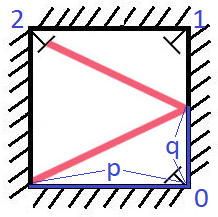
Input: p = 2, q = 1
Output: 2
Explanation: The ray meets receptor 2 the first time it gets reflected back to the left wall.
Example 2:
Input: p = 3, q = 1
Output: 1
Constraints:
1 <= q <= p <= 1000
Approaches
3 approaches with complexity analysis and trade-offs.
This approach directly simulates the path of the laser ray. We can simplify the physics by tracking how many times the ray crosses the room horizontally (extensions) and what its total vertical displacement is. The ray starts at (0,0) and first hits the east wall at (p,q). Each time it travels horizontally by p, it travels vertically by q. We can loop, incrementing the horizontal traversals and accumulating the vertical distance, until the ray's height is a multiple of p, which signifies it has landed on a corner.
Algorithm
- Initialize state variables:
extensions = 0to count horizontal room traversals andy = 0for the total vertical distance traveled. - Enter an infinite loop, as the problem guarantees a solution.
- In each iteration, increment
extensionsby 1, representing the ray crossing the room horizontally one more time. - Add
qto the total vertical distancey. - Check if the ray has hit a corner. A corner is hit when the total vertical distance
yis a multiple of the room heightp. This is checked withy % p == 0. - If a corner is hit:
a. Calculate the number of vertical room traversals (or reflections off the top/bottom walls),
reflections = y / p. b. Check the parity ofreflectionsto determine if the ray hit the top wall (reflectionsis odd) or the bottom wall (reflectionsis even). c. Check the parity ofextensionsto determine if the ray hit the right wall (extensionsis odd) or the left wall (extensionsis even). d. Based on the combination of wall hits, determine the receptor and return its number: - Right wall, Top wall: Receptor 1. - Left wall, Top wall: Receptor 2. - Right wall, Bottom wall: Receptor 0. - Left wall, Bottom wall: This is the starting point, so the loop would have continued. This logic ensures we find the first receptor hit.
Walkthrough
We can model the ray's journey without using floating-point coordinates. Let's track the number of times the ray crosses the room from one vertical wall to the other, which we'll call extensions. We also track the total vertical distance traveled, y.
Initially, extensions = 0 and y = 0. In a loop, we simulate one horizontal traversal at a time. We increment extensions and add q to y. We then check if the ray has landed on a corner. A corner is located at height 0 or p. This occurs when the total vertical distance y is a multiple of p.
When y % p == 0, we've found a corner. We then need to identify which one.
- The number of horizontal traversals,
extensions, tells us which vertical wall we're on. Ifextensionsis odd, we're on the right wall (x=p). Ifextensionsis even, we're on the left wall (x=0). - The number of vertical traversals,
y / p, tells us which horizontal wall we're on. Ify / pis odd, we're on the top wall (y=p). Ify / pis even, we're on the bottom wall (y=0).
By combining these two pieces of information, we can pinpoint the exact receptor and return its number.
class Solution { public int mirrorReflection(int p, int q) { int extensions = 0; int y = 0; while (true) { extensions++; y += q; if (y % p == 0) { int reflections = y / p; if (extensions % 2 == 1) { // Right wall if (reflections % 2 == 1) { return 1; // Receptor 1 (p, p) } else { return 0; // Receptor 0 (p, 0) } } else { // Left wall // reflections must be odd to hit a receptor on the left wall return 2; // Receptor 2 (0, p) } } } }}Complexity
Time
O(p) - In the worst-case scenario (when `p` and `q` are coprime), the loop will run `p` times before finding a solution. The number of iterations is `p / gcd(p, q)`.
Space
O(1) - We only use a few integer variables to store the state.
Trade-offs
Pros
The logic is intuitive as it follows the physical path of the ray.
It avoids floating-point arithmetic, preventing precision issues.
Cons
The number of iterations depends on the input values
pandq, and can be large. The time complexity is linear with respect topin the worst case.It is significantly less efficient than mathematical approaches for larger inputs.
A highly efficient way to solve this problem is to change the frame of reference. Instead of reflecting the laser ray, we can 'unfold' or 'unroll' the room. Imagine the plane is tiled with copies of the square room. The path of the laser, with all its reflections, becomes a single straight line in this tiled plane. The problem is then reduced to finding the first corner of any tiled room that this straight line passes through.
Algorithm
- Understand that reflecting a ray inside a room is equivalent to tiling the plane with copies of the room and letting the ray travel in a straight line.
- The ray's path is a line from
(0,0)with slopeq/p, so its equation isY = (q/p) * X. - The ray hits a corner of a tiled room when its coordinates
(X, Y)are(m*p, n*p)for some integersmandn. - Substitute these coordinates into the line equation:
n*p = (q/p) * (m*p), which simplifies tom*q = n*p. - We need the smallest positive integers
mandnthat satisfy this equation. This is a classic Least Common Multiple (LCM) problem. The solution ism = p / gcd(p, q)andn = q / gcd(p, q). - Determine the receptor based on the parity of
m(number of horizontal room extensions) andn(number of vertical room extensions):mis odd,nis odd: The ray hits the right wall (x=p) and the top wall (y=p). This is Receptor 1.mis even,nis odd: The ray hits the left wall (x=0) and the top wall (y=p). This is Receptor 2.mis odd,nis even: The ray hits the right wall (x=p) and the bottom wall (y=0). This is Receptor 0.
- Implement a function to calculate the Greatest Common Divisor (GCD), for example, using the Euclidean algorithm.
Walkthrough
The laser starts at (0,0) and its path has a slope of q/p. The equation of this path in the unfolded grid is Y = (q/p) * X. We are looking for the first point (X, Y) on this line where X is a multiple of p and Y is also a multiple of p. Let this point be (m*p, n*p).
Plugging this into the line equation gives n*p = (q/p) * (m*p), which simplifies to n*p = m*q. We are looking for the smallest positive integers m and n that satisfy this. This is equivalent to finding the least common multiple of p and q. We can find m and n by dividing the equation by gcd(p, q):
m * (q/gcd(p,q)) = n * (p/gcd(p,q))
Since p/gcd(p,q) and q/gcd(p,q) are coprime, the smallest integer solution is:
m = p / gcd(p, q)
n = q / gcd(p, q)
Now, m represents the number of horizontal room traversals and n represents the vertical ones. The parity of m and n tells us the final corner:
modd,nodd ->(p, p)-> Receptor 1meven,nodd ->(0, p)-> Receptor 2modd,neven ->(p, 0)-> Receptor 0 (Note:mandncannot both be even, becausep/gcdandq/gcdare coprime).
class Solution { public int mirrorReflection(int p, int q) { int g = gcd(p, q); int m = p / g; int n = q / g; if (m % 2 == 0) { // m is even, n must be odd return 2; } else { // m is odd if (n % 2 == 1) { return 1; } else { return 0; } } } // Euclidean algorithm to find GCD private int gcd(int a, int b) { while (b != 0) { int temp = b; b = a % b; a = temp; } return a; }}Complexity
Time
O(log(min(p, q))) - The time complexity is dominated by the Euclidean algorithm for finding the GCD.
Space
O(1) - The iterative GCD algorithm uses constant extra space. A recursive implementation would use O(log(min(p,q))) stack space.
Trade-offs
Pros
Extremely fast, with logarithmic time complexity.
Provides a direct, deterministic solution without any loops.
Mathematically elegant and robust.
Cons
Requires a conceptual leap to transform the reflection problem into a geometry problem on a grid.
Involves implementing or using a GCD function.
This approach is a further optimization of the geometric method. It recognizes that the core of the problem lies in the parity of the room extension counts (m and n). Instead of computing the full Greatest Common Divisor (GCD), we can simplify p and q by repeatedly dividing out their common factors of 2. This is sufficient to determine the parities needed to identify the final receptor, leading to a very simple and fast algorithm.
Algorithm
- Observe that the final receptor depends only on the parity of
m = p/gcd(p,q)andn = q/gcd(p,q). - The key insight is that we can determine these parities without computing the full GCD. Any common factor of 2 in
pandqwill also be ingcd(p,q). We can remove these common factors first. - Use a
whileloop to repeatedly divide bothpandqby 2 as long as they are both even. This effectively removes the power-of-2 component from the GCD. - After the loop, the new
pandqare not both even. Let's call themp'andq'. The remaininggcd(p', q')must be an odd number. - Since
m = p'/gcd(p',q')andgcd(p',q')is odd, the parity ofmis the same as the parity ofp'. Similarly, the parity ofnis the same as the parity ofq'. - Therefore, we can simply check the parities of the simplified
pandq:- If
pis even (andqmust be odd): This corresponds tombeing even andnbeing odd. Return 2. - If
pis odd andqis odd: This corresponds tomandnboth being odd. Return 1. - If
pis odd andqis even: This corresponds tombeing odd andnbeing even. Return 0.
- If
Walkthrough
Building on the geometric approach, we know the result depends on the parity of m = p/gcd(p,q) and n = q/gcd(p,q). Let's analyze the effect of factors of 2.
Any common factor of 2 between p and q will be part of their GCD. We can simplify the fraction p/q by dividing both p and q by 2 until at least one of them becomes odd. This process is equivalent to dividing p and q by 2^k, where 2^k is the highest power of 2 that divides gcd(p,q).
After this simplification, let the new values be p' and q'. The remaining gcd(p', q') will be an odd number. When we compute m = p'/gcd(p',q'), dividing by an odd number does not change the parity. Thus, parity(m) == parity(p'). The same logic applies to n, so parity(n) == parity(q').
This means we can find the result by this simple procedure:
- Remove all common factors of 2 from
pandq. - Check the parity of the resulting
pandqto find the answer.
This avoids the more complex multiplications and divisions of a full GCD algorithm, replacing them with simple bit shifts or divisions by 2.
class Solution { public int mirrorReflection(int p, int q) { while (p % 2 == 0 && q % 2 == 0) { p /= 2; q /= 2; } // At this point, at least one of p or q is odd. if (p % 2 == 0) { // p is even, q must be odd. // m = p/g is even, n = q/g is odd. return 2; } else { // p is odd if (q % 2 == 1) { // p is odd, q is odd. // m = p/g is odd, n = q/g is odd. return 1; } else { // p is odd, q is even. // m = p/g is odd, n = q/g is even. return 0; } } }}Complexity
Time
O(log(min(p, q))) - The number of divisions by 2 is limited by the number of bits in the smaller of `p` or `q`.
Space
O(1) - Only a few variables are used, requiring constant space.
Trade-offs
Pros
The most efficient approach in terms of raw performance, as it uses simpler arithmetic operations (division by 2 and parity checks) than a full GCD.
The code is extremely concise and clean.
Cons
The reasoning behind why this simplification works is subtle and relies on number theory properties.
Solutions
Solution
class Solution {public int mirrorReflection(int p, int q) { int g = gcd(p, q); p = (p / g) % 2; q = (q / g) % 2; if (p == 1 && q == 1) { return 1; } return p == 1 ? 0 : 2; }private int gcd(int a, int b) { return b == 0 ? a : gcd(b, a % b); }}class Solution {public: int mirrorReflection(int p, int q) { int g = __gcd(p, q); p = (p / g) % 2; q = (q / g) % 2; if (p == 1 && q == 1) { return 1; } return p == 1 ? 0 : 2; }};class Solution: def mirrorReflection(self, p: int, q: int) -> int: g = gcd(p, q) p = (p // g) % 2 q = (q // g) % 2 if p == 1 and q == 1: return 1 return 0 if p == 1 else 2Video walkthrough
Newsletter
One sharp idea, every week
System design and interview prep — short enough to finish.
No spam. Unsubscribe anytime.
Practice
Same difficulty — related problems to reinforce the pattern.