
Number of Different Subsequences GCDs
HardPrompt
You are given an array nums that consists of positive integers.
The GCD of a sequence of numbers is defined as the greatest integer that divides all the numbers in the sequence evenly.
- For example, the GCD of the sequence
[4,6,16]is2.
A subsequence of an array is a sequence that can be formed by removing some elements (possibly none) of the array.
- For example,
[2,5,10]is a subsequence of[1,2,1,2,4,1,5,10].
Return the number of different GCDs among all non-empty subsequences of nums.
Example 1:
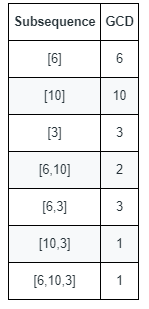
Input: nums = [6,10,3]
Output: 5
Explanation: The figure shows all the non-empty subsequences and their GCDs.
The different GCDs are 6, 10, 3, 2, and 1.
Example 2:
Input: nums = [5,15,40,5,6]
Output: 7
Constraints:
1 <= nums.length <= 1051 <= nums[i] <= 2 * 105
Approaches
2 approaches with complexity analysis and trade-offs.
A straightforward but inefficient approach is to check for every possible integer k, whether it can be the GCD of some subsequence. The possible values for a GCD are limited by the maximum value in the input array nums. For each potential GCD k, we can form a subsequence by picking all numbers from nums that are multiples of k. If this subsequence is non-empty, we compute its GCD. If the result is exactly k, then k is a valid GCD, and we count it.
Algorithm
- Find the maximum value
maxValin the input arraynums. - Initialize a counter
countto 0. - Iterate
kfrom 1 tomaxVal. Thiskis a potential GCD. - For each
k, create a temporary list of all numbers innumsthat are multiples ofk. - If this list of multiples is not empty, compute the GCD of all numbers in it.
- If the computed GCD is equal to
k, it meanskis a valid subsequence GCD. Incrementcount. - After iterating through all possible
k, return the totalcount.
Walkthrough
The logic is based on the definition of a subsequence GCD. For any number k to be the GCD of a subsequence, there must exist a set of numbers in the original array nums such that:
- All numbers in the set are multiples of
k. - The greatest common divisor of all numbers in the set is exactly
k.
This approach directly translates this logic into code. We iterate through all possible GCD values k from 1 up to the maximum element in nums. For each k, we scan the entire nums array, collect all multiples of k, and then compute their GCD. If this GCD equals k, we've found a valid subsequence GCD.
class Solution { private int gcd(int a, int b) { while (b != 0) { int temp = b; b = a % b; a = temp; } return a; } public int countDifferentSubsequenceGCDs(int[] nums) { int maxVal = 0; for (int num : nums) { maxVal = Math.max(maxVal, num); } int count = 0; for (int i = 1; i <= maxVal; i++) { // Find the GCD of all numbers in nums that are multiples of i int currentGcd = 0; for (int num : nums) { if (num % i == 0) { if (currentGcd == 0) { currentGcd = num; } else { currentGcd = gcd(currentGcd, num); } } } // If the computed GCD is i, then i is a valid subsequence GCD if (currentGcd == i) { count++; } } return count; }}Complexity
Time
O(M * N * log(M)), where `N` is the length of `nums` and `M` is the maximum value in `nums`. The outer loop runs `M` times. Inside, we iterate through `N` numbers, and computing the GCD of up to `N` numbers takes `O(N * log(M))`. This is too slow for the given constraints.
Space
O(1) if we don't count the storage for multiples, or O(N) if we store them in a list for each potential GCD, where N is the number of elements in `nums`.
Trade-offs
Pros
Simple to understand and implement.
Correctly solves the problem without complex data structures.
Cons
Highly inefficient due to nested loops over potential GCDs and the entire input array.
Will result in a 'Time Limit Exceeded' error for the given constraints.
This approach improves upon the naive one by optimizing the search for multiples. Instead of iterating through the entire nums array for each potential GCD k, we first mark all numbers from nums in a boolean present array. Then, for each k, we iterate only through its multiples (k, 2k, 3k, ...) and check their presence in the map. This avoids the costly O(N) scan for each k and makes the solution efficient enough to pass within the time limits.
Algorithm
- Find the maximum value
maxValinnums. - Create a boolean array
presentof sizemaxVal + 1to mark which numbers are present in the input array. This allows for O(1) lookups. - Initialize a
countof different GCDs to 0. - Iterate with a variable
ifrom 1 tomaxVal. Thisirepresents a potential GCD. - For each
i, find the GCD of all its multiples that are present innums. To do this, iteratejfromitomaxValwith a step ofi(j = i, 2i, 3i, ...). - If
present[j]is true, update thecurrentGcdforiwithj. - If the final
currentGcdforiis equal toi, it meansiis a valid subsequence GCD, so incrementcount. - Return the total
count.
Walkthrough
The core idea remains the same: a number k is a valid subsequence GCD if the GCD of all numbers in nums that are multiples of k is exactly k. The key optimization is how we find these multiples and compute their GCD.
- First, we determine the maximum value
maxValinnumsand create a boolean arraypresentof sizemaxVal + 1. We populate this array by iterating throughnums, sopresent[x]is true ifxis innums. - Then, we iterate
ifrom 1 tomaxVal. For eachi, we want to find the GCD of its multiples present innums. - Instead of scanning
nums, we scan through the multiples ofidirectly:j = i, 2*i, 3*i, ...up tomaxVal. - For each
j, we checkpresent[j]. If it's true, we update the GCD for the currenti. - If, after checking all multiples, the calculated GCD is equal to
i, we've found a new distinct subsequence GCD.
An additional small optimization is that during the calculation of the GCD for i, if the currentGcd becomes equal to i, we can stop early, as it's the smallest possible non-zero GCD we can get (since all numbers are multiples of i).
class Solution { private int gcd(int a, int b) { // Handle gcd(0, x) = x if (a == 0) return b; while (b != 0) { int temp = b; b = a % b; a = temp; } return a; } public int countDifferentSubsequenceGCDs(int[] nums) { int maxVal = 0; for (int num : nums) { maxVal = Math.max(maxVal, num); } boolean[] present = new boolean[maxVal + 1]; for (int num : nums) { present[num] = true; } int count = 0; for (int i = 1; i <= maxVal; i++) { int currentGcd = 0; // Iterate through multiples of i for (int j = i; j <= maxVal; j += i) { if (present[j]) { currentGcd = gcd(currentGcd, j); } // Optimization: if we've already found a GCD of i, // no smaller GCD is possible for this subsequence. if (currentGcd == i) { break; } } if (currentGcd == i) { count++; } } return count; }}Complexity
Time
O(M * log(M) * log(M)), where `M` is the maximum value in `nums`. The total number of iterations of the inner loop across all `i` is given by the harmonic series sum `M/1 + M/2 + ... + M/M`, which is `O(M * log(M))`. Each step in the inner loop involves a GCD operation, which takes `O(log(M))`. Thus, the total complexity is `O(M * log^2(M))`.
Space
O(M), where `M` is the maximum value in `nums`. This is for the `present` boolean array.
Trade-offs
Pros
Significantly more efficient than the naive approach.
Passes within the time limits for the given constraints.
The logic is a clever and direct application of number theory properties.
Cons
Requires extra space proportional to the maximum value in
nums, which could be large.
Solutions
Solution
class Solution {public int countDifferentSubsequenceGCDs(int[] nums) { int mx = Arrays.stream(nums).max().getAsInt(); boolean[] vis = new boolean[mx + 1]; for (int x : nums) { vis[x] = true; } int ans = 0; for (int x = 1; x <= mx; ++x) { int g = 0; for (int y = x; y <= mx; y += x) { if (vis[y]) { g = gcd(g, y); if (x == g) { ++ans; break; } } } } return ans; }private int gcd(int a, int b) { return b == 0 ? a : gcd(b, a % b); }}class Solution {public: int countDifferentSubsequenceGCDs(vector<int> &nums) { int mx = *max_element(nums.begin(), nums.end()); vector<bool> vis(mx + 1); for (int &x : nums) { vis[x] = true; } int ans = 0; for (int x = 1; x <= mx; ++x) { int g = 0; for (int y = x; y <= mx; y += x) { if (vis[y]) { g = gcd(g, y); if (g == x) { ++ans; break; } } } } return ans; }};class Solution: def countDifferentSubsequenceGCDs(self, nums: List[int]) -> int: mx = max(nums) vis = set(nums) ans = 0 for x in range(1, mx + 1): g = 0 for y in range(x, mx + 1, x): if y in vis: g = gcd(g, y) if g == x: ans += 1 break return ansVideo walkthrough
Newsletter
One sharp idea, every week
System design and interview prep — short enough to finish.
No spam. Unsubscribe anytime.
Practice
Same difficulty — related problems to reinforce the pattern.