
Search a 2D Matrix
MedPrompt
You are given an m x n integer matrix matrix with the following two properties:
- Each row is sorted in non-decreasing order.
- The first integer of each row is greater than the last integer of the previous row.
Given an integer target, return true if target is in matrix or false otherwise.
You must write a solution in O(log(m * n)) time complexity.
Example 1:
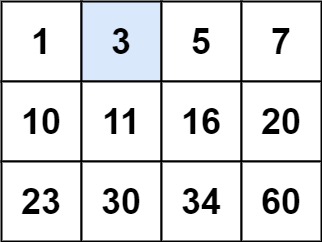
Input: matrix = [[1,3,5,7],[10,11,16,20],[23,30,34,60]], target = 3
Output: true
Example 2:
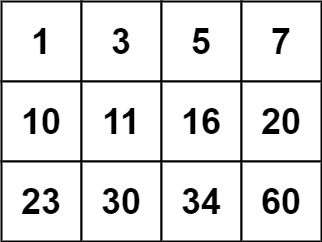
Input: matrix = [[1,3,5,7],[10,11,16,20],[23,30,34,60]], target = 13
Output: false
Constraints:
m == matrix.lengthn == matrix[i].length1 <= m, n <= 100-104 <= matrix[i][j], target <= 104
Approaches
4 approaches with complexity analysis and trade-offs.
This is the most straightforward but least efficient approach. We can simply iterate through every cell of the m x n matrix and check if the element at that cell is equal to the target. This method does not take advantage of the matrix's special sorted structure.
Algorithm
- Get the dimensions of the matrix,
m(rows) andn(columns). - Iterate through each row
ifrom0tom-1using a for loop. - For each row
i, iterate through each columnjfrom0ton-1using a nested for loop. - Inside the inner loop, check if the element
matrix[i][j]is equal to thetarget. - If a match is found, return
trueimmediately. - If the loops complete without finding the
target, returnfalseafter the loops finish.
Walkthrough
The algorithm uses two nested loops to traverse the matrix. The outer loop iterates through the rows from index 0 to m-1, and the inner loop iterates through the columns from index 0 to n-1. In each iteration of the inner loop, we compare the current element matrix[row][col] with the target value. If they are equal, we have found the target and can return true. If we traverse the entire matrix and do not find the target, the loops will complete, and we return false.
class Solution { public boolean searchMatrix(int[][] matrix, int target) { int m = matrix.length; if (m == 0) { return false; } int n = matrix[0].length; for (int i = 0; i < m; i++) { for (int j = 0; j < n; j++) { if (matrix[i][j] == target) { return true; } } } return false; }}Complexity
Time
O(m * n)
Space
O(1)
Trade-offs
Pros
Very simple to understand and implement.
Works on any 2D matrix, regardless of whether it's sorted or not.
Cons
Highly inefficient as it does not leverage the sorted properties of the matrix.
Fails to meet the
O(log(m * n))time complexity requirement specified in the problem description.
Solutions
Solution
class Solution { public boolean searchMatrix ( int [][] matrix , int target ) { int m = matrix . length , n = matrix [ 0 ]. length ; int left = 0 , right = m * n - 1 ; while ( left < right ) { int mid = ( left + right ) >> 1 ; int x = mid / n , y = mid % n ; if ( matrix [ x ][ y ] >= target ) { right = mid ; } else { left = mid + 1 ; } } return matrix [ left / n ][ left % n ] == target ; } }Video walkthrough
Newsletter
One sharp idea, every week
System design and interview prep — short enough to finish.
No spam. Unsubscribe anytime.
Practice
Same difficulty — related problems to reinforce the pattern.