
Set Matrix Zeroes
MedPrompt
Given an m x n integer matrix matrix, if an element is 0, set its entire row and column to 0's.
You must do it in place.
Example 1:
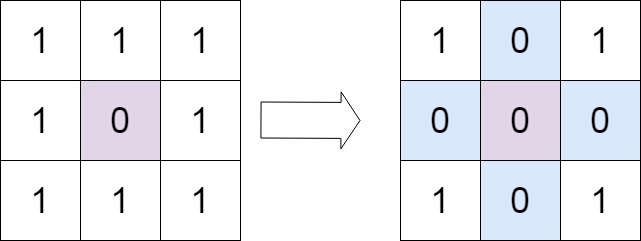
Input: matrix = [[1,1,1],[1,0,1],[1,1,1]]
Output: [[1,0,1],[0,0,0],[1,0,1]]
Example 2:
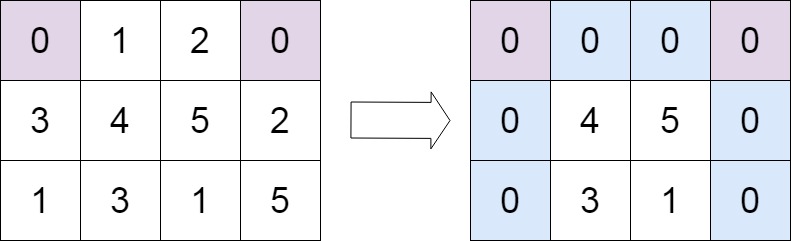
Input: matrix = [[0,1,2,0],[3,4,5,2],[1,3,1,5]]
Output: [[0,0,0,0],[0,4,5,0],[0,3,1,0]]
Constraints:
m == matrix.lengthn == matrix[0].length1 <= m, n <= 200-231 <= matrix[i][j] <= 231 - 1
Follow up:
- A straightforward solution using
O(mn)space is probably a bad idea. - A simple improvement uses
O(m + n)space, but still not the best solution. - Could you devise a constant space solution?
Approaches
3 approaches with complexity analysis and trade-offs.
The most straightforward approach is to use an auxiliary matrix of the same dimensions as the original. We can iterate through the original matrix to find the locations of all the zeros. Then, based on these locations, we modify the auxiliary matrix by setting the corresponding rows and columns to zero. Finally, we copy the contents of the auxiliary matrix back to the original one. This approach is simple to conceptualize but highly inefficient in terms of space.
Algorithm
- Create a new matrix
ansof sizem x nand copy the originalmatrixinto it. - Iterate through the original
matrixfrom(i, j) = (0, 0)to(m-1, n-1). - If
matrix[i][j]is0:- Set all elements in row
iof theansmatrix to0. - Set all elements in column
jof theansmatrix to0.
- Set all elements in row
- After the iteration is complete, copy the
ansmatrix back to the originalmatrix.
Walkthrough
This method avoids the problem of modifying the matrix while iterating over it, which could lead to a chain reaction of zeroing out unintended rows and columns. By using a separate copy, we can safely record all the required changes before applying them.
Here's the breakdown:
- Create a new matrix, let's call it
ans, with the same dimensionsm x nand copy all elements from the originalmatrixinto it. - Iterate through the original
matrixusing nested loops for rowiand columnj. - If you find an element
matrix[i][j]that is0, you then perform two more loops to set the entirei-th row andj-th column of theansmatrix to0. - After the initial iteration over the original matrix is complete, the
ansmatrix holds the desired final state. The last step is to copy theansmatrix back into the originalmatrixto satisfy the in-place requirement.
class Solution { public void setZeroes(int[][] matrix) { int m = matrix.length; int n = matrix[0].length; int[][] ans = new int[m][n]; // Create a copy of the original matrix for (int i = 0; i < m; i++) { for (int j = 0; j < n; j++) { ans[i][j] = matrix[i][j]; } } // Iterate through the original matrix to find zeros for (int i = 0; i < m; i++) { for (int j = 0; j < n; j++) { if (matrix[i][j] == 0) { // Set the entire row in the 'ans' matrix to 0 for (int k = 0; k < n; k++) { ans[i][k] = 0; } // Set the entire column in the 'ans' matrix to 0 for (int k = 0; k < m; k++) { ans[k][j] = 0; } } } } // Copy the 'ans' matrix back to the original matrix for (int i = 0; i < m; i++) { for (int j = 0; j < n; j++) { matrix[i][j] = ans[i][j]; } } }}Complexity
Time
O((m*n) * (m+n))
Space
O(m*n)
Trade-offs
Pros
Very simple and easy to understand.
Separates the logic of finding zeros from modifying the matrix, avoiding common pitfalls.
Cons
Extremely high space complexity, making it impractical for large matrices.
Inefficient time complexity, especially for matrices with many zeros.
Solutions
Solution
public class Solution { public void SetZeroes(int[][] matrix) { int m = matrix.Length, n = matrix[0].Length; bool i0 = matrix[0].Contains(0), j0 = false; for (int i = 0; i < m; ++i) { if (matrix[i][0] == 0) { j0 = true; break; } } for (int i = 1; i < m; ++i) { for (int j = 1; j < n; ++j) { if (matrix[i][j] == 0) { matrix[i][0] = 0; matrix[0][j] = 0; } } } for (int i = 1; i < m; ++i) { for (int j = 1; j < n; ++j) { if (matrix[i][0] == 0 || matrix[0][j] == 0) { matrix[i][j] = 0; } } } if (i0) { for (int j = 0; j < n; ++j) { matrix[0][j] = 0; } } if (j0) { for (int i = 0; i < m; ++i) { matrix[i][0] = 0; } } }}Video walkthrough
Newsletter
One sharp idea, every week
System design and interview prep — short enough to finish.
No spam. Unsubscribe anytime.
Practice
Same difficulty — related problems to reinforce the pattern.